The line is not waiting on a part. It is waiting on one fixture.
A checking fixture cracks on second shift. There is no second one. It was built once, four years ago, by a tool shop three states away, and the drawing on file is not quite the drawing that was actually made. The line finishes the lot in front of it and then stops, because nothing downstream can be signed off without that fixture. Nobody on the floor is waiting for a part number a supplier can pull from a shelf. They are waiting for one object that exists in exactly one place.
Tooling and fixture moves look like ordinary urgent freight on a rate sheet and behave nothing like it in the field. The difference is not weight or distance. It is that the thing being moved is unique, usually unpackaged, awkward in a way no standard trailer configuration anticipates, and sitting at an origin that has never shipped anything on an expedited basis in its life.
The origin is a toolroom, not a shipping department
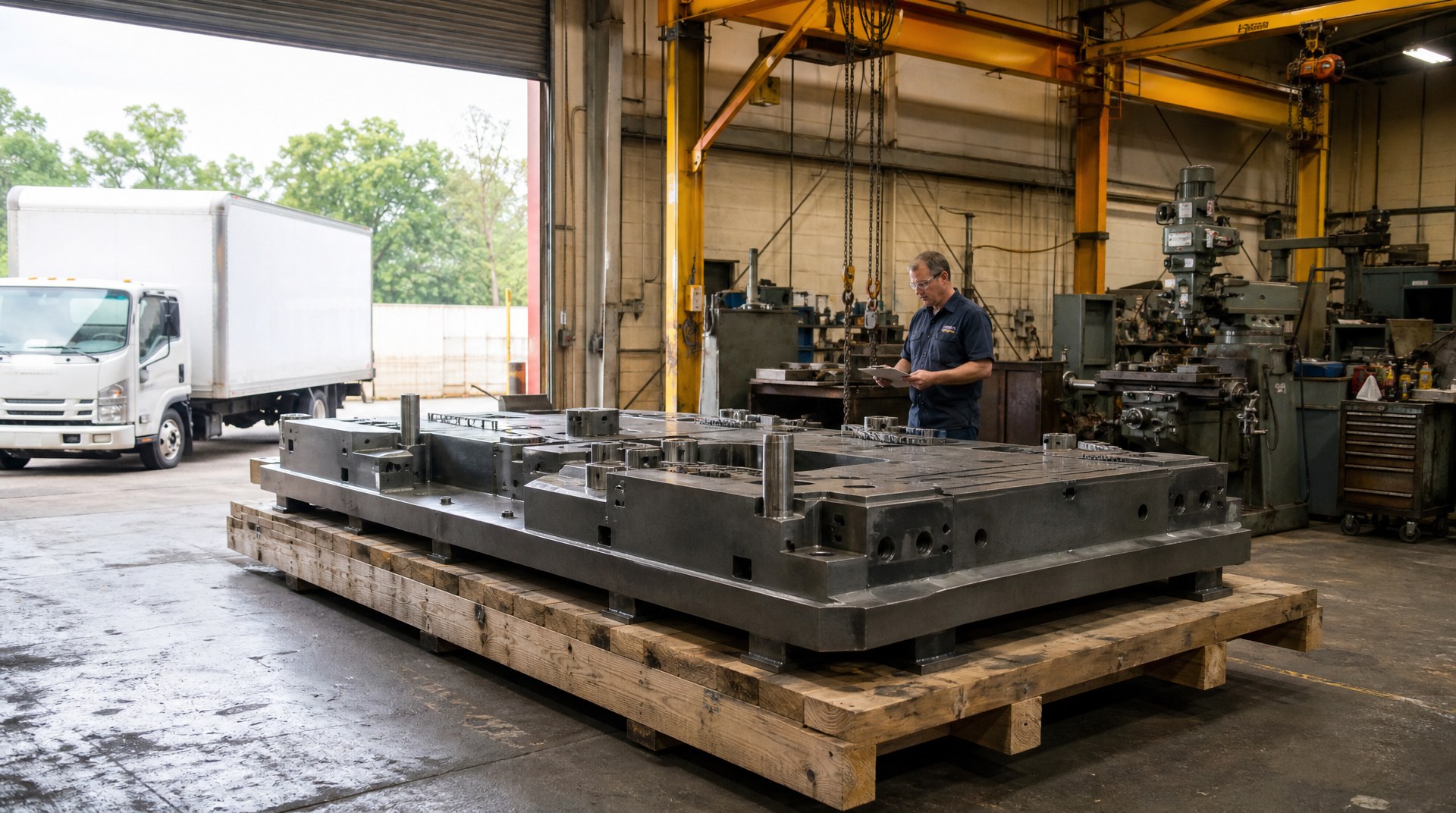
The first thing that goes wrong is at pickup. A production part comes from a warehouse with a dock, a forklift, a shipping clerk and a printer. A repaired fixture comes from a tool and die shop where the loading area is a roll-up door at grade, the only lift truck is rated well below what is about to go on it, and the person who knows the job is a machinist who will be gone at four.
That changes the equipment decision before anything else. A dry van backed to a grade-level door with no leveler cannot be loaded by hand if the fixture weighs eleven hundred pounds. A flatbed can take it from the side with a shop crane, but then the load is exposed and has to be tarped and secured properly. A liftgate straight truck solves the dock problem and creates a weight ceiling. None of those three is obviously correct, and picking wrong is not a rate problem, it is a truck that arrives and leaves empty.
The question that resolves it takes one phone call to the shop, not to the buyer: what is the actual weight, what are the actual dimensions with the base and any protective frame attached, and what can you physically get it onto a truck with. Buyers give nominal numbers from a drawing. Machinists give the number on the shop scale.
Nothing about a fixture is packaged for a highway
A production part travels in packaging designed by someone who expected it to travel. A fixture usually travels in whatever the shop has, which is often a wooden base, a pallet it was never bolted to, and a shrink wrap job done at the end of the day. Precision surfaces, locating pins and sensors are frequently exposed, and the failure mode is not the fixture falling off the truck. It is the fixture arriving intact but out of tolerance, which is worse, because it will be discovered at the plant after everyone has already declared the recovery finished.
Securement of an irregular, top-heavy object is a genuine technical question rather than a formality, and the federal cargo securement rules in 49 CFR Part 393 set the floor rather than the target. The practical version on a tooling move is that the fixture gets blocked and braced against movement in every direction, that straps do not bear on machined faces, and that whoever loads it is told which surfaces matter. A driver who is handed an unlabelled steel object will secure it as steel. A driver who is told where the datum surfaces are will secure it as a tool.
Repair, replace, or move the work instead
Before any of the freight decisions matter there is a prior one that the plant sometimes makes too slowly. There are usually three ways out of a broken fixture, and they have very different freight consequences. The tool can be repaired at a shop, which means two moves rather than one and a clock that includes machining time. A replacement can be pulled from another plant in the network, which is often faster and is the option people forget because it crosses an internal boundary. Or the work itself can move to where a working fixture already is, which is not a tooling move at all but a parts move in the opposite direction.
The freight side should be asked to price all three before the plant commits to one, because the fastest repair is regularly slower than the least obvious transfer. A desk running an expedited recovery move can usually tell you within an hour which of the three actually restarts the line first, and that hour is well spent before a truck is dispatched anywhere.
The same reasoning that governs how fast a stopped line recovers applies here with one extra variable, which is that the object in question cannot be substituted. Every other line-down decision has a fallback somewhere in the supply base. This one does not, and that is why the sequencing matters more than the speed.
The receiving end is the toolroom, not receiving
A returning fixture does not go to the line. It goes to the toolroom to be checked, refitted and signed off, and the toolroom keeps different hours from receiving and sometimes sits on the other side of the plant. A fixture delivered at 5 AM into a receiving lane will be booked in as inbound freight and will sit there until somebody who knows what it is walks past it.
That is the same last stretch that swallows recoveries on the parts side, and it is worth arranging in the same phone call. Name the person in the toolroom who is expecting it, confirm they are on shift at the delivery hour, and make sure the crate is marked for the toolroom rather than for stores. The freight cost of getting that wrong is zero and the schedule cost is a full shift. The pattern is identical to the one that shows up in the last two hundred yards of a recovery, where the freight arrives on time and the plant clock has not started.
Ask the shop three questions before you book anything
Three answers decide whether a tooling move goes cleanly or turns into a second recovery. What does the shop scale say the fixture weighs, with its base and frame attached, and what are its real dimensions. What can the origin physically load it with, and does that match the truck being sent. And who at the destination is expecting it, in which department, at what hour. Get those three and the move is ordinary. Skip them and a truck goes to a shop that cannot load it, or a one of a kind fixture arrives out of tolerance, or it sits in a receiving lane while the line stays down. Walk a single-tool move through with a desk that has loaded fixtures off shop floors before, not one that will quote it as freight and find out at the door.