Short answer
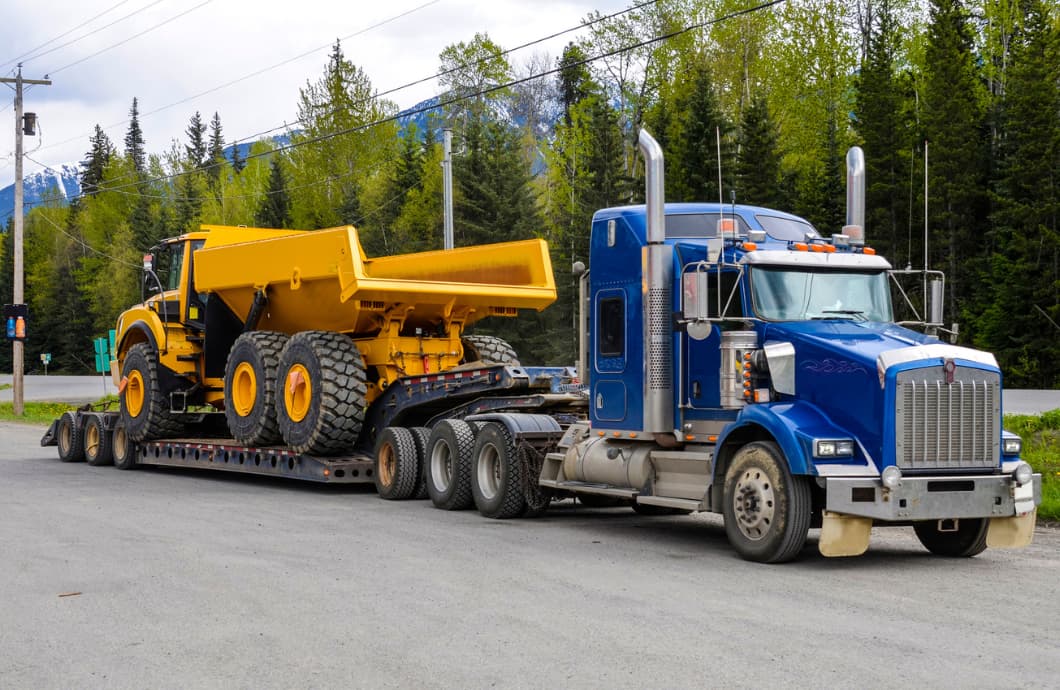
A lowboy trailer is a semitrailer with two drops in its deck, one behind the gooseneck and one in front of the rear axles, which puts the cargo deck lower to the ground than any other open trailer. That low deck is the entire point of the design. It lets a tall, heavy machine ride under the legal height limit without a permit that a flatbed would have forced.
A lowboy is also written “low boy”, and “lowboy truck” usually means the tractor and the lowboy trailer together rather than a separate kind of truck. This page covers what a lowboy is, how the drop deck works, what the legal dimensions and weights actually are, how many axles a lowboy runs, the types of lowboy trailer, and how a lowboy differs from an RGN and a double drop.
What Is a Lowboy Trailer?
Lowboy trailer
An open semitrailer whose deck drops twice, immediately behind the gooseneck and again ahead of the rear axle group, creating a low central well for cargo. The well sits closer to the road than the deck of a flatbed or a step deck, which is what allows tall equipment to travel within legal height.
The lowboy exists for one constraint: height. A flatbed carries its load high, so a machine of any real height on a flatbed goes over the legal limit and needs an oversize permit, a route survey and often escorts. Drop the deck and the same machine travels legally.
Everything else about a lowboy follows from that. The well is low, so it is short: the length is spent on the two ramps down and up. Ground clearance under the well is small, so a lowboy is sensitive to steep driveway aprons, railway crossings and yard entrances that a flatbed crosses without thinking. And the deck cannot be loaded from the side over the wheels the way a flatbed can, so a lowboy is loaded from the front or the rear.
“Lowboy meaning” in one line: it is the low-deck trailer that heavy equipment rides on.
How Does a Lowboy Trailer Work?
Front to back, a lowboy is four parts.
- The gooseneck. The section that connects to the tractor’s fifth wheel and carries the front of the load. On some lowboys it is fixed; on others it detaches, which is what makes the trailer loadable from the front.
- The first drop. The deck steps down immediately behind the gooseneck.
- The well, or main deck. The low load-carrying section between the drops. This is where the machine sits and the reason the trailer exists.
- The second drop and the axle group. The deck rises again over the rear axles.
The load is secured in the well, so the height of the cargo is measured from a deck that starts far lower than a flatbed’s. That difference is the whole trade: you lose deck length and ground clearance, and you gain legal height.
What Is a Lowboy Truck?
“Lowboy truck” is used two ways and both are worth separating.
- The combination. A tractor pulling a lowboy trailer. This is what people mean nine times out of ten, and it is why “lowboy truck” and “lowboy trailer” return the same equipment.
- The trailer alone. In yard and dispatch language a “lowboy” is the trailer, never the tractor.
A lowboy is not a truck type in the way a box truck or a dump truck is. There is no lowboy chassis with an engine in it. A lowboy driver is a driver hauling on a lowboy trailer, usually with a heavy haul background because the loading, securement and route work are the hard parts of the job.
What Are the Dimensions of a Lowboy Trailer?
This is where most answers online quote a spec sheet from one manufacturer as if it were a rule. The honest split is between what the law fixes and what the model decides.
| Dimension | What is actually fixed | Source |
|---|---|---|
| Width | 102 inches on the National Network. No state may set a limit above or below it, and a wider load moves on a special use permit | 23 CFR 658.15(a) and 658.15(c) |
| Height | Not a federal number at all. 23 CFR part 658 regulates length, width and weight and contains no height section; height is a state limit, and 13 feet 6 inches is the figure that recurs in the state entries of that part | 23 CFR part 658, sections 658.13, .15, .17: no height section |
| Length | No state may impose a semitrailer length limit below 48 feet in a tractor-semitrailer combination, and no state may impose an overall length limit on that combination | 23 CFR 658.13(b)(1) and (b)(3) |
| Deck height and well length | Model-specific. This varies by axle configuration, suspension and neck type, and there is no legal figure | Manufacturer specification, not published here, see below |
| Ground clearance under the well | Model-specific, and the operationally important number on the day. It is what decides whether the trailer clears the apron at the pickup, not what appears in a brochure | Manufacturer specification |
The number that matters on a real job is not the trailer’s deck height, it is the total travelling height, deck plus machine, measured against the limit of every state on the route. Below that limit the load is legal freight. Above it, the load is an oversize move with permits, and possibly curfews and escorts, in every state it crosses.
We are not publishing a deck-height or well-length range. Those figures are manufacturer specifications that differ by model and we did not verify one from a primary source. Ask for the spec of the specific trailer being assigned to your load and measure your machine: an estimate off a web page is exactly the wrong input to a height decision.
How Much Weight Can a Lowboy Trailer Haul?
Two ceilings apply and the lower one wins.
- The federal ceiling. On the Interstate System the maximum gross vehicle weight is 80 000 pounds, with a maximum of 20 000 pounds on any single axle and 34 000 pounds on a tandem axle group, and the Bridge Gross Weight Formula limits what any group of consecutive axles may carry regardless of those numbers (23 CFR 658.17(b), (c), (d), (e)). That 80 000 pounds is the whole combination (tractor, trailer and cargo), not the cargo alone.
- The trailer’s own rating. A manufacturer rating for the specific trailer and axle configuration. We are not publishing a range for it, for the same reason as above.
Above the federal ceiling the move does not become impossible, it becomes permitted. States issue overweight permits with their own axle-spacing rules, routes and, above certain weights, bridge analysis. That is normal work for heavy haul and it is planned before the load is booked, not discovered at a scale.
Bridge Gross Weight Formula
The federal rule relating axle spacing to allowable weight, so that a given group of axles may carry more the further apart they are. It is why an extra axle or a longer spread raises legal capacity, and why two lowboys with the same deck can be legal at different weights.
How Many Axles Does a Lowboy Trailer Have?
There is no single answer, and the reason is the bridge formula above rather than manufacturer preference.
A two-axle lowboy is the common configuration for ordinary equipment moves. Three, four and more axles, including add-on jeeps and boosters ahead of and behind the trailer, appear as the load gets heavier, because spreading the same weight across more axles and a longer distance is precisely what the formula rewards. The axle count is therefore chosen from the weight and the route, not from the trailer catalogue.
The practical consequence for a shipper: the right question is never “how many axles does your lowboy have”, it is “what does this machine weigh and where is it going”. The axle count is the answer to that, not an input to it.
What Are the Types of Lowboy Trailer?
| Type | What distinguishes it | Where it fits |
|---|---|---|
| Fixed gooseneck (FGN) | The gooseneck does not detach. Loading is from the rear, over ramps | Lighter, longer machines that can be driven on; the simplest and lightest trailer |
| Removable gooseneck (RGN) | The gooseneck detaches so the front of the deck lowers to the ground and becomes its own ramp | Self-propelled machines that drive straight on from the front |
| Fixed-neck lowboy | Neck and deck are one piece; the trailer is loaded by crane | Loads that are lifted on anyway, where the neck is dead weight |
| Hydraulic detachable | The gooseneck detaches and lowers under hydraulic power rather than by hand | Frequent detaching, heavier loads, faster turnarounds |
| Multi-axle lowboy | Additional axles, jeeps or boosters | Weights above what two or three axles can carry legally |
The type is a loading decision before it is a weight decision. How the machine gets onto the deck (driven on from the front, driven on from the rear, or lifted) picks the trailer.
Lowboy vs RGN vs Double Drop: What Is the Difference?
These three names overlap in practice, which is why the comparison queries exist.
| Deck shape | Gooseneck | How it loads | |
|---|---|---|---|
| Lowboy | Two drops, low well between them | Fixed or removable | Rear ramps, or from the front if the neck detaches |
| RGN (removable gooseneck) | A lowboy: same two-drop deck | Detaches by definition | Front, with the deck lowered to the ground as the ramp |
| Double drop | Two drops, low well between them | Usually fixed | Ramps or crane |
The clean way to hold it: an RGN is a lowboy, the term names the detachable neck, not a different deck. “Double drop” names the deck shape and is often used interchangeably with lowboy. In a heavy haul quote the meaningful distinction is not the label, it is whether the neck comes off, because that is what decides whether a machine can be driven on from the front.
What Does a Lowboy Trailer Haul?
Anything too tall for a flatbed and too heavy to be worth splitting up.
- Excavators, dozers, graders and loaders
- Cranes and crane components
- Drilling and mining equipment
- Agricultural machinery: combines, large tractors
- Transformers, industrial plant and pressure vessels
- Military and other tracked vehicles
The common thread is height first, weight second. A load can be very heavy and still travel on a step deck; the moment it is tall, the lowboy is the trailer that keeps it legal.
How Do You Book Lowboy Transport?
Four things decide the booking, and a carrier that does not ask for all four is guessing.
- Dimensions and weight of the machine, measured rather than remembered: length, width, height and weight, with attachments in the position they will travel in.
- How it loads and unloads at both ends. Driven on or lifted; the surface, the gradient and the overhead at each site. This is where ground clearance under the well decides the trailer.
- The route. Total travelling height against each state’s limit, bridges, and whether the move needs permits, curfews or escorts. Permit lead time is a real constraint on the pickup date.
- Securement. Chains and binders sized to the machine, and any disassembly needed to get under height.
LAX Freight moves this equipment on lowboy and RGN trailers, including permitted oversize and overweight loads. Send the four items above and you get a trailer type, a route and a legal travelling height, not just a price.
What is a lowboy trailer?
A lowboy trailer is an open semitrailer with two drops in its deck, creating a low well between the gooseneck and the rear axles. The low deck lets tall, heavy equipment travel under the legal height limit that the same machine would exceed on a flatbed.
What is a lowboy truck?
“Lowboy truck” normally means the tractor and lowboy trailer together. There is no separate lowboy chassis: the lowboy is the trailer, and a lowboy driver is a driver hauling on one, usually with a heavy haul background.
How long is a lowboy trailer?
There is no legal lowboy length, and the honest answer is that overall length is set by the model and the axle configuration. What the law fixes is that no state may impose a semitrailer length limit below 48 feet in a tractor-semitrailer combination, and no state may impose an overall length limit on that combination at all (23 CFR 658.13). The usable well is always much shorter than the trailer, because the deck spends length dropping and rising.
How many axles does a lowboy trailer have?
Two is the common configuration; three, four or more appear as loads get heavier, along with jeeps and boosters. The count is driven by the federal Bridge Gross Weight Formula, which allows more weight the further apart the axles are, so the axle count is chosen from the weight and the route.
How high off the ground is a lowboy?
Deck height and ground clearance are manufacturer specifications that differ by model, suspension and axle setup, and we do not publish an unverified range for them. The number that governs a real move is the total travelling height, deck plus machine, against each state’s height limit, since federal law sets no height limit at all.
Written by the LAX Freight heavy haul desk. Reviewed 31.08.2026. Every size and weight limit on this page is taken from 23 CFR part 658 and cited to the section it comes from. Deck heights, well lengths and per-model trailer capacities are manufacturer specifications; we did not verify one from a primary source, so we do not publish a range: where a figure could not be checked, we say so rather than estimate.