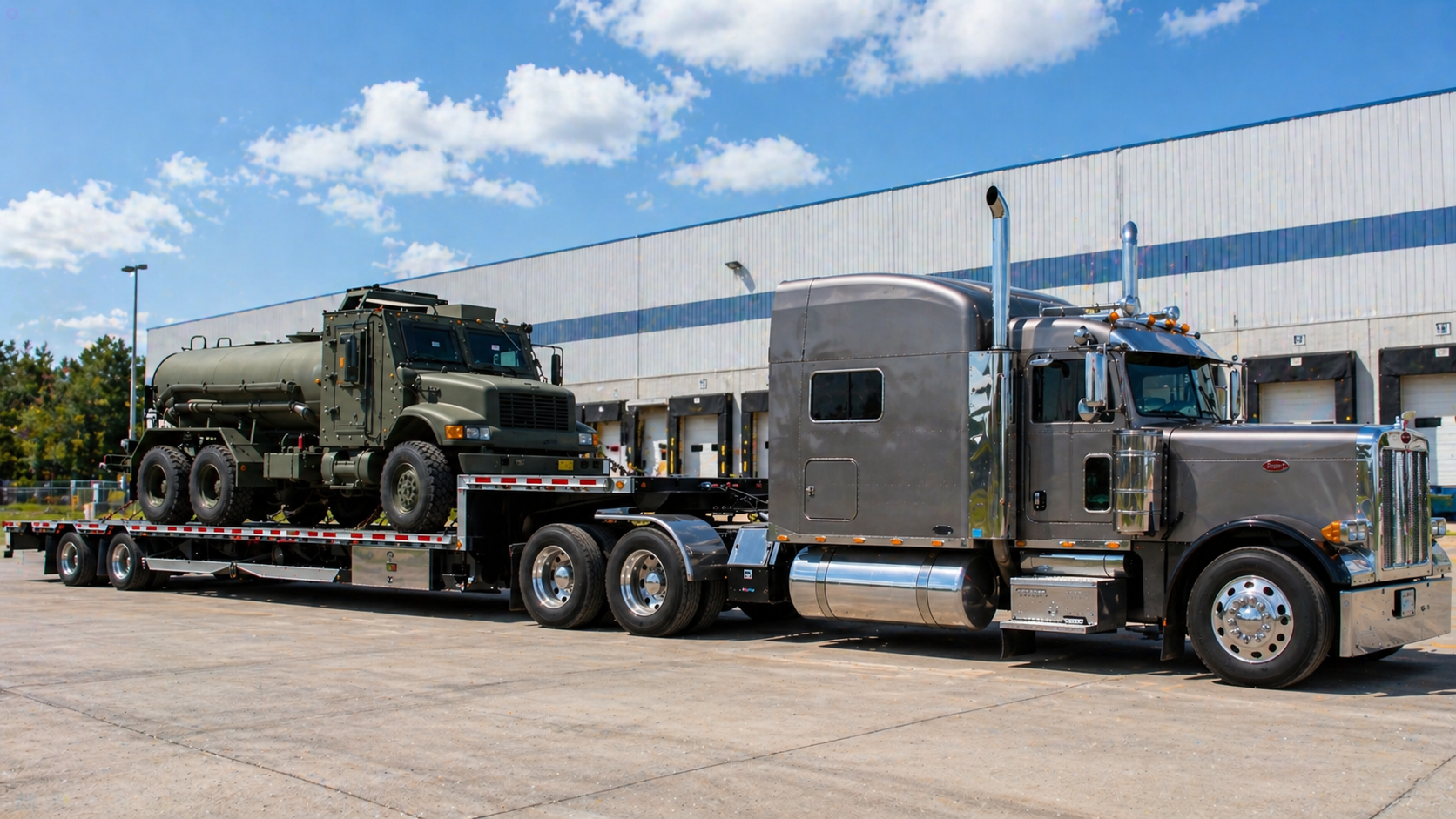
What Defense Contractors Find Out Too Late About DOD Freight
The shipment gets rejected at the receiving dock. The carrier didn’t have the right documentation. The packaging didn’t meet military spec. The labeling was missing a required field. The contractor now has a delayed delivery, a potential contract violation, and a carrier dispute — all because the freight setup that works fine for commercial customers doesn’t work for DOD.
This is common because DOD freight operates under standards that are not optional, not negotiable at the dock, and not something a standard commercial freight broker is equipped to manage. Defense contractors who treat military freight like commercial freight eventually learn the difference the hard way.
This guide covers what DOD freight actually requires — packaging, labeling, documentation, transportation security — and where the compliance failures consistently happen.
Military Packaging Standards: MIL-STD-2073
DOD packaging is governed by MIL-STD-2073, the Department of Defense Standard Practice for Military Packaging. This is a contractual requirement on virtually every defense supply contract. Military cargo moves through environments and handling chains that commercial packaging isn’t designed for: stored in depots, airlifted in military aircraft, moved through forward operating environments. Packaging failures here don’t just result in damaged product — they can affect mission readiness.
MIL-STD-2073 specifies packaging method codes, preservation requirements, cushioning, barrier materials, moisture protection, and unit pack construction. Requirements vary by item category, unit of issue, and contract specification — no single template. Each contract’s packaging requirements need to be read and applied specifically.
Common failures: commercial packaging used for items that require Level A military preservation. Wrong barrier material for humidity-sensitive components. Skipped preservation steps to save time. The receiving inspector at a military depot has no discretion. Non-conforming packaging is rejected, full stop.
Military Labeling: MIL-STD-129
MIL-STD-129 governs identification marking of U.S. military property. Every unit pack, intermediate pack, and exterior shipping container needs to be labeled to standard — specific about content, format, barcode symbology (PDF417 or Data Matrix, depending on application), and placement.
Required label data: National Stock Number (NSN) or part number, contract number, lot/batch number, unit of issue, quantity, and shipping unit identification. For serialized items, serial number tracking has to carry through the label. For hazardous materials, additional DOT and DOD marking requirements layer on top.
The label feeds into DOD’s item tracking and asset visibility systems. A label missing data, using the wrong barcode format, or with fields in the wrong position creates downstream tracking failures in military inventory systems — and that shows up on the contractor’s performance record.
Transportation Documentation: DD Form 1149 and Bill of Lading Requirements
DOD freight requires specific documentation that commercial freight doesn’t. The DD Form 1149 (Requisition and Invoice/Shipping Document) is the primary shipping document for government property. It captures the contract number, requisition number, National Stock Number, item description, quantity, and shipping/receiving information. It needs to accompany the shipment and match the physical cargo.
For freight moving under government bills of lading (GBL), the documentation requirements add another layer. The carrier must be authorized under the applicable transportation service contract or rate tender. The GBL must accurately reflect freight charges, commodity, weight, and routing. Discrepancies between the GBL and the actual shipment create audit findings — and the Defense Contract Audit Agency (DCAA) audits freight costs.
DCAA reviews freight expenditures for allowability, allocability, and reasonableness under FAR Part 31. Freight costs that can’t be traced to a specific contract deliverable, that appear excessive relative to market rates, or incurred through non-compliant carriers can be disallowed — the contractor eats the cost. Documentation discipline around freight is a financial issue, not just an operational one.
Transportation Security Requirements
DOD cargo security requirements vary based on what’s being shipped, but the baseline is substantially higher than commercial freight. For sensitive conventional arms, ammunition, and explosives (AA&E), DOD Instruction 5100.76 sets specific transportation security requirements: carrier qualification, vehicle security, communication requirements, and chain-of-custody controls.
For classified shipments, the requirements are governed by the National Industrial Security Program Operating Manual (NISPOM) and the applicable facility clearance and transportation plan. A cleared contractor can’t just book capacity — the carrier and driver need to meet the specific security requirements for that cargo category.
Even for unclassified controlled cargo, GPS tracking is increasingly required. The Defense Logistics Agency (DLA) and military service transportation offices specify tracking requirements in their contracts. A carrier that can’t provide real-time GPS tracking is disqualified from many DOD loads regardless of general freight capabilities.
Carrier vetting for DOD freight means verifying FMCSA operating authority, required security certifications, driver personnel requirements, and equipment specifications. That’s not a five-minute check — it’s a qualification process that has to happen before the truck rolls, not after.
For defense contractors that need a freight partner equipped to handle DOD packaging, labeling, documentation, and security requirements, LAX Freight’s government and defense freight capabilities are built around exactly this kind of compliance work.
Where Contractors Consistently Fail on DOD Freight
Using commercial carriers without DOD qualification. A carrier that moves commercial freight competently may have no experience with MIL-STD-129 labeling, no understanding of DD Form 1149, and may not meet the security requirements for the cargo. The contractor finds out at the receiving dock.
Treating freight as outside the compliance scope. Contractors invest heavily in compliance for engineering, quality, and program management. Freight often gets treated as a procurement function that just needs to move cargo at a reasonable rate. But freight is part of the contract performance chain. A late or rejected delivery caused by a non-compliant freight setup can trigger liquidated damages or affect past performance ratings.
Inadequate carrier backup. Defense contracts have tight delivery windows. If the primary carrier falls through, the contractor needs a qualified backup. A standard commercial broker finds whoever is available. For DOD freight, available isn’t the same as qualified.
Documentation gaps at handoff. Chain-of-custody gaps create audit exposure. If a shipment changes hands at a transload facility and the documentation doesn’t reflect that transfer, the contractor has a compliance gap in the record. These get discovered, and they create findings.
The DCAA Angle: Freight Cost Allowability
DCAA is the audit risk most contractors don’t consider when thinking about freight compliance.
DCAA audits whether costs charged to a government contract are allowable under FAR Part 31. A cost is allowable if it’s reasonable, allocable to a specific contract, and compliant with applicable laws and regulations. If the freight setup used non-compliant carriers, if documentation is insufficient to allocate costs to specific contracts, or if rates appear unreasonable, DCAA can — and does — disallow those costs.
For contractors billing freight as direct charges, documentation needs to support the specific contract allocation. For contractors billing freight as overhead, the allocation methodology needs to be consistent and defensible. Either way, a freight broker who doesn’t understand government cost accounting requirements creates DCAA risk.
How LAX Freight Handles DOD Compliance
The carriers we use for DOD freight are vetted against the specific requirements for the load: FMCSA authority, applicable security certifications, GPS tracking capability, and personnel qualifications. We verify before we dispatch.
Documentation is managed at every step. DD Form 1149 accuracy, GBL requirements, chain-of-custody documentation at each transfer point — these are part of the shipment process, not afterthoughts. The contractor gets a documentation package that supports DCAA review if it comes.
Packaging and labeling compliance support is part of how we work with contractors newer to DOD freight. If the packaging or labeling doesn’t meet MIL-STD-2073 or MIL-STD-129, the shipment will be rejected. We flag those issues before the cargo is picked up.
When urgency is a factor — and in defense freight, it usually is — we have the carrier base to respond without compromising the qualification process. Urgency means having enough vetted capacity to move fast within the compliance framework, not skipping the vetting steps.
Defense contractors managing ITAR-controlled items within their DOD freight operations face additional compliance layers. Our guide on ITAR freight shipping covers what that requires specifically.
If your DOD freight includes ITAR-controlled cargo or other specialty requirements, LAX Freight’s carrier vetting and documentation process is built to handle that without creating compliance exposure at the handoff points.
A pattern of late or rejected DOD deliveries shows up in past performance ratings, which directly affect future competitive positioning on federal awards. Our guide on how to win government freight contracts covers SAM.gov, GSA MAS, and what makes brokers competitive in the government freight space.
For the full picture of how LAX Freight operates in the government and defense freight space, visit our government and defense shipping page.