The ITAR Freight Problem Most Contractors Miss
Most discussions about ITAR freight shipping focus on exports — licenses, restricted countries, and State Department filings. Domestic freight gets almost no attention: the moves that never cross a border, the transfers between facilities that happen every week, the shipments that look routine until something goes wrong.
ITAR — the International Traffic in Arms Regulations, governed under 22 CFR §§ 120–130 — controls the export and temporary import of defense articles and services on the United States Munitions List (USML). But “export” under ITAR trips up contractors and their logistics teams constantly. A disclosure of ITAR-controlled technical data to a foreign national on U.S. soil is an export. A transfer of controlled hardware to a facility where uncleared personnel have access is a potential violation. The freight broker you’ve used for years, who’s never asked about USML classifications, who sends whatever driver is available — they’re a liability you may not have priced into your contract.
This isn’t fixed by signing a compliance checklist.
What ITAR Actually Requires in a Freight Context
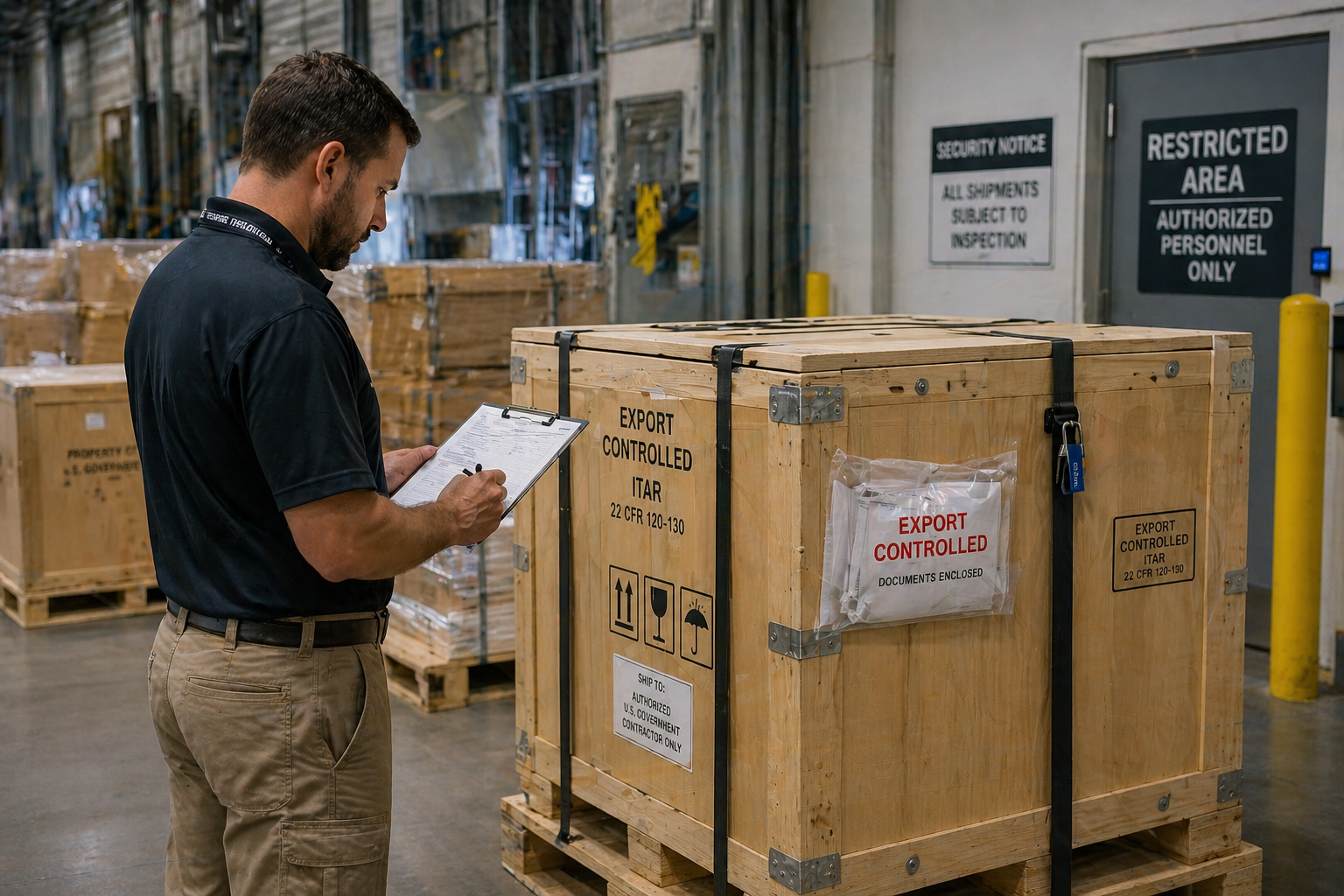
ITAR doesn’t prescribe how freight must physically move. It requires a defensible chain of custody demonstrating controlled items were handled exclusively by authorized parties, with no unauthorized disclosure, and with accurate and complete transfer documentation. In practice, that means operational requirements most commercial freight brokers aren’t equipped to meet.
ECCN Classification and USML Determination. Before a shipment moves, someone has to know what they’re moving. In practice, contractors still ship hardware under vague descriptions — “components,” “assemblies,” “parts” — because the commercial freight system doesn’t demand more. ITAR does. Every item on the USML needs proper classification, and if there’s any ambiguity about whether something is EAR or ITAR controlled, that determination needs to be made before the truck is loaded. Misclassification isn’t a paperwork technicality; it’s the first link in a chain that can lead to a State Department violation.
Export Licenses and Authorization Documentation. If the shipment involves an export — including deemed exports — the applicable license or exemption needs to travel with the cargo documentation. A carrier who loses the paperwork or can’t explain what it covers isn’t just an inconvenience; they’re a compliance gap.
Carrier Vetting and ITAR-Cleared Personnel. This is where most freight setups break. Standard brokerage assigns loads to available capacity. ITAR shipments require carriers whose drivers and handling personnel meet the access requirement for controlled items — typically U.S. persons under 22 CFR § 120.15. Verifying citizenship status isn’t a conversation most freight brokers have had with their carrier base. It has to happen before dispatch, not after.
Chain-of-Custody Documentation. Every transfer point needs to be documented: who had the cargo, when, under what conditions. In the event of a State Department audit, a documented chain of custody is the difference between demonstrating compliance and trying to reconstruct it from memory.
Why Standard Freight Brokers Are a Liability
The freight brokerage industry operates on margin and volume. A broker moving hundreds of loads a week is optimizing for speed and rate — not for the compliance requirements of a cargo category most of their clients don’t ship.
The result is predictable. A contractor with an ITAR-controlled shipment calls their usual broker. The broker finds a carrier, books the load, sends the driver. Nobody asked whether the driver is a U.S. person. Nobody asked whether the carrier has handled ITAR cargo before. Nobody looked at the USML category on the hardware, because the broker didn’t know to ask and the contractor assumed someone else was managing it.
This isn’t hypothetical. It’s the standard outcome when ITAR-controlled freight gets routed through commercial logistics channels without explicit compliance controls.
The stakes are real. Under 22 CFR § 127.10, civil penalties for ITAR violations can reach $1,000,000 per violation. Criminal penalties under 22 U.S.C. § 2778 can include up to 20 years in prison. The State Department’s Directorate of Defense Trade Controls (DDTC) has pursued enforcement actions against contractors and their logistics providers. “We didn’t know the broker wasn’t vetting carriers” is not a defense that holds up.
For contractors working with ITAR-controlled materials who need a freight partner that understands compliance at this level, LAX Freight’s government and defense freight capabilities are built around exactly this kind of work.
What an ITAR-Compliant Freight Setup Actually Looks Like
ITAR freight isn’t solved with a form or a policy — it requires a process built around the compliance requirement from the start.
Pre-shipment documentation review. Before anything moves, the shipper’s documentation is reviewed for accuracy: USML classification, export license or exemption applicability, destination, and end-user information where relevant. Gaps get resolved before dispatch, not during transit.
Carrier qualification for the specific load. Not a general carrier approval — a specific review of whether the carrier and driver assigned to this shipment meet the personnel requirements for ITAR cargo. Citizenship verification, not assumptions.
Shipment-level chain-of-custody documentation. Every handoff documented, every transfer point logged. The documentation that travels with the cargo and the records retained after delivery need to be sufficient to demonstrate compliance in an audit.
Urgency handling that doesn’t compromise compliance. Defense freight is often urgent. The answer for time-critical ITAR cargo isn’t cutting corners on carrier vetting — it’s having a qualified carrier base deep enough to respond quickly without breaking the compliance process. When an air shipment is stuck and airport storage is accumulating at $9,000+ per day, the pressure is real. Speed within the compliance framework, not instead of it.
The Documentation Failures That Create Violations
Most ITAR freight violations in a logistics context don’t happen because someone deliberately circumvented the regulations. They happen because documentation failures compound.
An ECCN is misclassified on the commercial invoice. A license exemption is cited that doesn’t apply. A driver who isn’t a U.S. person handles cargo because nobody checked. A chain-of-custody gap appears because a carrier changed hands mid-transit and the documentation wasn’t updated.
None of these look serious when they happen. They become serious when DDTC comes looking, or when an end-use monitoring visit surfaces a discrepancy, or when a foreign national is identified in a chain-of-custody record for a USML item.
The compliance structure isn’t complex — but it has to be built deliberately. It doesn’t appear automatically because a contractor has an internal compliance program. The freight provider has to be part of it.
How LAX Freight Handles ITAR Shipments
The carrier base is vetted for ITAR eligibility. Drivers assigned to ITAR loads are U.S. persons, verified before dispatch. We don’t rely on carriers to self-certify and move on.
Documentation is reviewed before the load moves. If the paperwork doesn’t support the shipment, the shipment doesn’t move until it does. That’s the only way to run ITAR freight without creating liability for the contractor.
Urgency is handled within the compliance framework. When a defense contractor has a critical shipment that needs to move now, we build speed into the carrier coordination — not by skipping steps. An ITAR shipment that moves fast and fails compliance doesn’t solve the contractor’s problem.
Chain-of-custody documentation is complete. Every handoff, every transfer point, every carrier assignment is documented and retained. The contractor has a clean record of how the cargo moved and who handled it.
If your shipments are ITAR-controlled and you’re routing them through standard commercial freight channels, that’s a compliance exposure worth addressing before it becomes a violation.
For contractors who need to understand the broader DOD freight compliance environment, including packaging standards and documentation requirements under military specifications, see our guide to DOD shipping requirements.
If your ITAR shipments need to move within a framework that keeps the compliance record clean, LAX Freight handles that coordination from carrier assignment through final delivery documentation.
For a full overview of how LAX Freight works within the government and defense freight space, visit our government and defense shipping page.