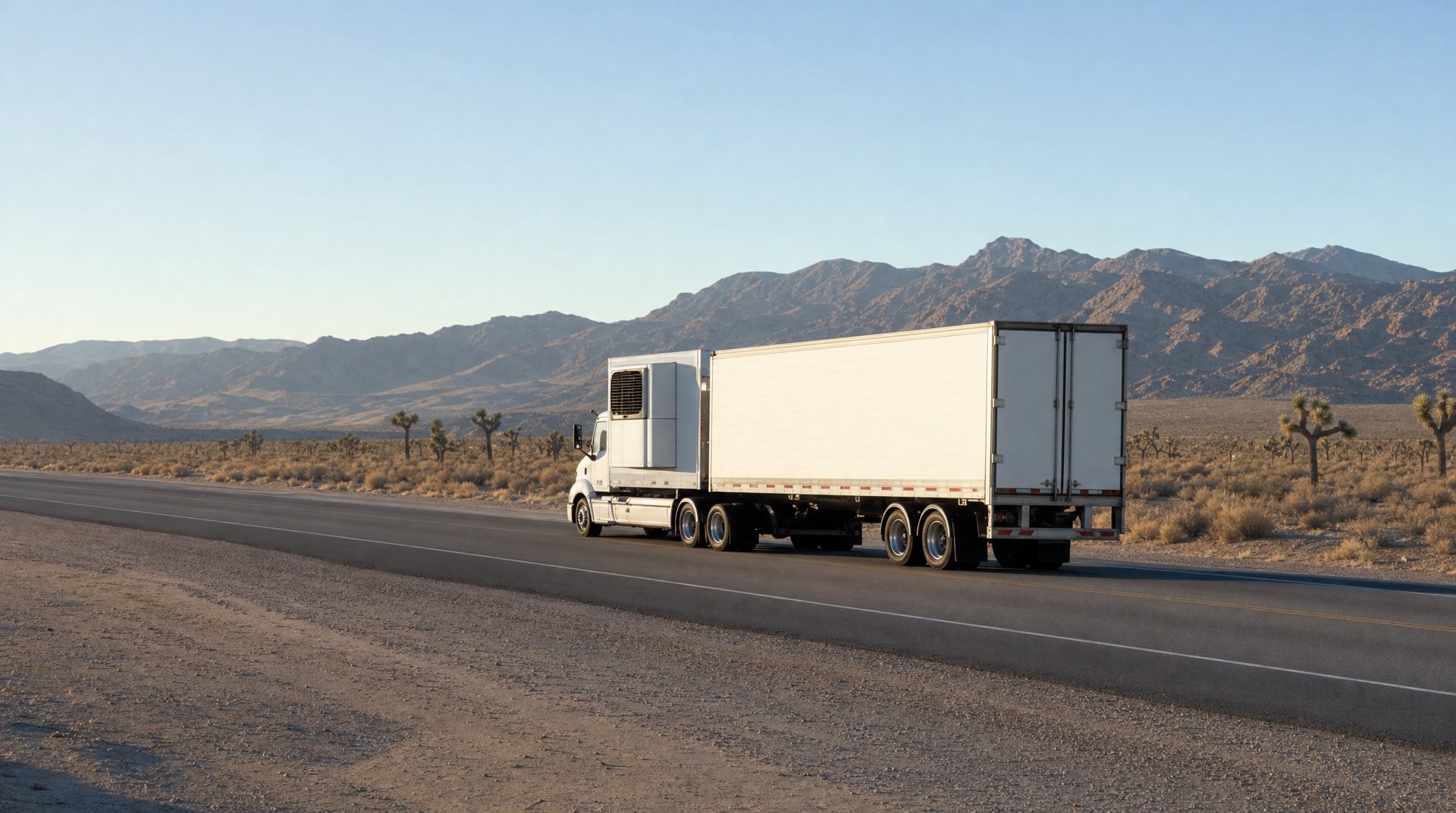
Refrigerated trucking from Los Angeles to Las Vegas is a short lane with a hard middle. It is roughly 270 miles up I-15, over the Cajon Pass and across the Mojave. A reefer can cover it in one driver’s shift, but the desert, the receiving docks and the paperwork decide whether the load arrives at the right temperature and gets accepted on the first try.
This guide is for the Los Angeles food or beverage shipper with product going to a Las Vegas distribution center, a foodservice warehouse or a resort receiving dock. It covers what to set before the trailer is loaded, how to plan the run around the heat and the appointment, what to put in writing, and what drives the price. If you already have the lane and the set-point, our refrigerated trucking service can quote it.
Why a short reefer lane still goes wrong
A one-day run feels low risk, so the details get skipped. Most problems on this lane trace back to one of four things:
- Warm product at loading. A reefer unit is built to hold a temperature, not to pull a warm load down to it. If pallets come off a dock that is warmer than the set-point, the trailer spends the trip catching up, and the product at the center of the pallet may never get there.
- A trailer that was not pre-cooled. Loading into a trailer still at desert ambient puts heat straight into the product. The carrier is expected to pre-cool to the temperature you specify, which means you have to specify it.
- Heat and door time at the other end. Las Vegas summers are hot, and every minute a door is open at a receiver without a sealed cold dock costs temperature. A truck that arrives outside its window and waits at the gate adds to it.
- A receiver who rejects the load. Receivers check product temperature at the door. If a reading looks wrong and nobody can show what the trailer did in transit, the argument starts on the dock with the product still on the truck.
None of these are fixed by a faster truck. They are fixed by what is agreed before pickup.
Set the temperature and the running mode before you book
The quote starts with the set-point, because it decides the equipment and the cost. Our reefer service moves four ranges:
| Range | Typical product | What to tell the carrier |
|---|---|---|
| Deep-frozen, down to -20°F | Ice cream, frozen protein, frozen bakery | Exact set-point, and that the product is already at temperature when it loads |
| Refrigerated, 34°F to 45°F | Produce, dairy, chilled meat, floral | Set-point, continuous running, and anything that should not ride next to it |
| Ambient and protect-from-freeze | Beverages, canned goods, liquids | The lowest temperature the product can tolerate; this matters more on a winter night through the high desert |
| Heated, up to 85°F | Chocolate, some adhesives | The range to stay inside, in both directions |
The running mode is the second decision. In continuous mode the unit runs all the time and keeps air moving through the load, which is what fresh produce and most chilled product need. In cycle mode the unit shuts off once the set-point is reached and restarts when the temperature drifts, which saves fuel and can suit well-packed frozen product. If you are not sure which your product needs, say so when you ask for a quote and decide it with the carrier, rather than leaving it to whatever the unit was last set to.
If one order mixes frozen and chilled product, it does not have to be two trucks. A dual-temp trailer runs two compartments at different set-points, so a frozen section and a chilled section can ship together to the same receiver.
Plan the run around the heat and the dock appointment
On this lane the clock that matters is the receiver’s, not the drive time. Work backward from the delivery appointment:
- Confirm the window and the dock. Ask the receiver for the appointment, the gate or dock address, check-in rules and whether there is a refrigerated dock. Resort and casino receiving areas often run tight windows on a busy back-of-house dock, and a missed slot can mean waiting for the next one.
- Pick a departure that lands early in the window. Leaving Los Angeles in the evening or overnight is a common way to make a morning appointment in Las Vegas and to cross the desert outside the hottest part of the day. Build in room for traffic out of the basin and for weather or closures on I-15.
- Load last-minute product last. Stage the pallets in a cold area until the trailer is pre-cooled and at the door, then load quickly with the unit off or set as the carrier advises for loading, and close up.
- Tell the carrier about waiting. If the receiver is known for making drivers sit, say so up front. It affects the rate and the plan, and it is cheaper than a surprise.
If the Las Vegas delivery is one of several stops, a multi-stop refrigerated route can carry the DC drop and the property drops on one trailer. Each stop opens the doors again, so put the most temperature-sensitive product where it comes off first or last, depending on where the unit can protect it best, and keep the stop count honest.
Put the temperature in writing
For food that needs temperature control for safety, federal sanitary transportation rules expect the shipper to give the carrier the operating temperature in writing, including the pre-cooling phase where it applies. The same section says the carrier, when it is responsible for sanitary conditions under the agreement, must pre-cool the trailer as specified and, if the shipper or receiver asks, show that it held the temperature, for example with readings at loading and unloading or time and temperature data from the trip (21 CFR 1.908).
In practice, before the first load on a new lane, settle these in writing with the carrier:
- The set-point and running mode for each commodity, and the pre-cool temperature.
- The acceptable range on arrival, so the receiver and the carrier read the same number.
- What temperature record you want at the end: a download from the unit, readings at load and unload, or both.
- Who to call, and what happens to the product, if a reading goes out of range on the way.
On the bill of lading for each load, write the set-point and mode, record product temperatures at loading and the seal number. If a Las Vegas receiver questions the load, that record and the trailer’s data are what settle it.
What a Las Vegas receiver checks at the door
Receivers differ, so ask yours for its requirements before the first delivery. Most food receivers look at some version of the same list:
- Arrival inside the appointment window, with the paperwork matching the purchase order.
- An intact seal with the number on the bill of lading.
- Product temperature, taken from the pallets, inside the range they accept.
- A clean trailer and loads that have not shifted or been crushed.
- For mixed loads, that raw product and nonfood items were kept apart from the food they could contaminate.
A rejected load on this lane is expensive in a specific way: the product is now in Las Vegas, at the wrong place, and still has to be kept cold while someone decides where it goes. That is why the written temperature and the in-transit record are worth more than they look.
What a reefer load from Los Angeles to Las Vegas costs
There is no single rate for the lane. The price is built from the same factors as any reefer move:
- Temperature and running mode. A deep-frozen load on continuous run burns more reefer fuel and engine hours than a protect-from-freeze load.
- Volume. A full truckload against refrigerated LTL, and how much of the trailer your pallets actually take up.
- Lane and timing. The delivery appointment, the number of stops, and whether the receiver has a cold dock or expects the driver to wait.
- Regional market conditions. Reefer capacity prices regionally, and lanes out of California tighten when trailers are pulled into produce season.
- Season and fuel. Produce and holiday peaks move the whole market, not only your lane.
If you ship to Las Vegas every week, or you know your peak weeks, bring the lane to a carrier before the market prices it. A regular load with a known set-point and a known receiver is easier to cover than a call made the morning it has to move.
If the order is only a few pallets, paying for a full trailer may be the wrong choice. Refrigerated LTL and partial loads are covered on our reefer service page, and the background on how the cold chain fits together is in our guide to cold chain logistics.
How LAX Freight moves refrigerated freight from Los Angeles to Las Vegas
LAX Freight is based in the Los Angeles area and arranges refrigerated freight through a pre-qualified network of carriers with refrigerated equipment, across the 48 contiguous states. On the Las Vegas lane that means full truckload or temperature-controlled LTL, single-temp and dual-temp trailers, continuous or cycle running, and multi-stop routes with temperature held from door to door. Loads are tracked and monitored 24/7, handling for food and pharmaceutical freight is aligned with FSMA and HACCP, and support is available around the clock from the quote to delivery.
To quote a load, we need the pickup and delivery points, the set-point, the commodity, the weight and pallet count, and your pickup window. Send those, and we will tell you what capacity looks like on the lane.