4:50 PM Friday, and the recovery has about an hour
The alert comes in at 4:50 PM on a Friday. A shipment that was supposed to be on tonight’s flight has fallen out of the plan, and the only version of this that ends well requires the freight to be pulled, documented, and handed off before the airline’s ground warehouse closes at six. That is roughly seventy minutes, most of which belongs to other people. What the next hour actually looks like on the forwarder’s floor is not dramatic. It is a sequence of small, ordinary moves that either line up or do not, and the freight does not care which.
This is one recovery, walked in real time, because the texture of the hour is the thing that rate sheets never show. The capability a forwarder is selling is not a heroic save. It is whether these seventy minutes are a routine they have run before or a scramble they are improvising.
The first ten minutes are triage, not action
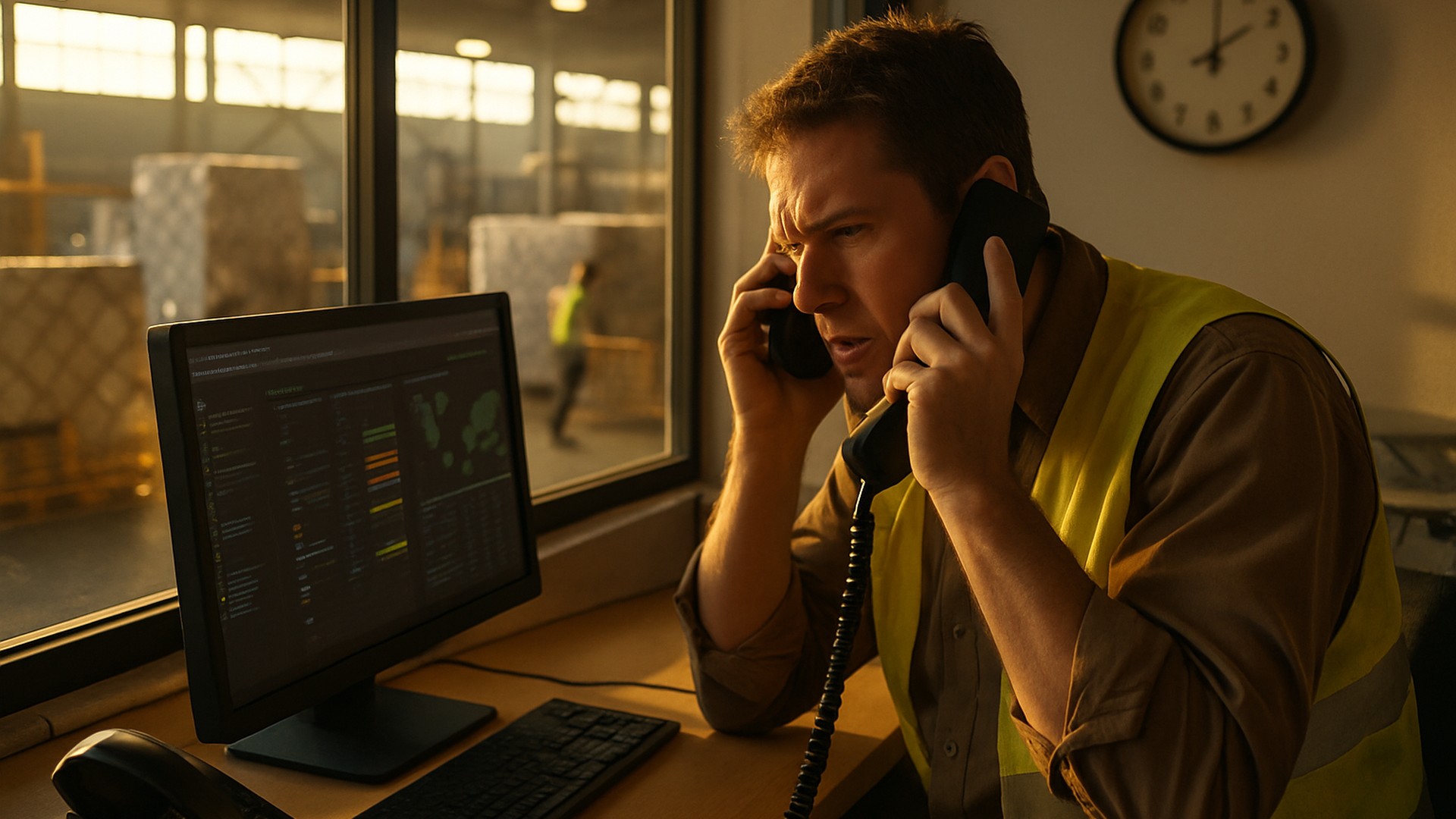
Nothing moves at 4:50. The first ten minutes are spent finding out what is actually true. Where is the freight right now, on a rack or already pulled. Is the warehouse close time really six or is there a check-in cutoff that lands earlier. Does the driver who would do this pickup exist and where are they. Is the paperwork in hand or does a delivery order still need to be issued. The desk that recovers well spends these ten minutes asking, not reacting, because a truck dispatched before the document set is confirmed just arrives early to wait. The desk that panics starts making calls in the wrong order and burns the window confirming things it should have known first. The good version of these ten minutes is almost boring to watch. One person works the phone in a fixed order, freight first, then carrier, then handler, then documents, and writes the answers where the rest of the desk can see them. The order is not improvised on the night. It is the same order every time, which is the only reason it fits inside ten minutes instead of thirty.
The hour, move by move
Laid out against the clock, a recovery that holds together looks like this.
| Time | What’s happening | What’s at risk |
|---|---|---|
| 4:50 | Alert lands; desk confirms freight location and real close time | Acting on a close time that is wrong by 30 minutes |
| 5:00 | Call to the ground carrier: is a driver reachable and where | The nearest driver is 45 minutes out, not 15 |
| 5:10 | Call to the airline handler: dock open, freight pulled, docs they accept | The pallet is still on a high rack, forklift operator gone |
| 5:20 | Delivery order issued, release and airway bill assembled | The consignee’s signer left for the weekend |
| 5:40 | Driver inbound, badge and gate clearance in motion | Gate guard handoff stalls for 15 quiet minutes |
| 5:55 | Pallet released against the document set, pickup posts | One wrong document version triggers a second call |
Every row has a quiet failure mode that has nothing to do with effort. The screening and handling steps in particular run on their own clock; air cargo moving through a US airport passes through TSA air cargo screening requirements that do not compress because a forwarder is in a hurry. The hour holds when each handoff lands on someone who is expecting it, and breaks when any one of them goes to voicemail.
The thesis in one line
The seventy minutes are not won by moving fast. They are won by knowing, before the alert, which of these steps is the one most likely to go quiet, and having a person already positioned on it.
What the floor sounds like, loud and quiet
The texture is counterintuitive. The loud parts of the hour are usually the parts that are fine: the calls connecting, the driver confirmed, the dock answering, voices overlapping because things are happening. The dangerous parts are quiet. The fifteen minutes where the driver is at the gate and nobody is talking because the badge clearance is stuck somewhere is silent, and that silence reads as progress when it is actually the window draining. The experienced desk listens for the wrong quiet. When a handoff goes still, they do not wait it out; they call into the silence before it becomes the reason the recovery missed. A floor that mistakes quiet for things-are-handled is the floor that discovers at 6:05 that the freight never left the rack.
Take the 5:40 row. The driver is physically at the airport, the freight is pulled, the documents are right; on paper the recovery is done. But the gate guard is mid shift-change and the badge clearance sits in a queue nobody is watching. From the desk it looks finished, so nothing gets done. Twelve minutes pass. At 5:52 someone finally asks the driver for a status and learns they never cleared the gate, and now there are eight minutes for a handoff that needs fifteen. Nobody was slow. The recovery was lost in a silence everyone read as success.
That is the part a customer never sees and the whole reason the hour either works or does not. It is the same discipline behind moving freight cleanly from priority recovery into warehouse inventory before the costly reclassification lands: not speed, but attention pointed at the step about to go quiet.
Or the last row of the table. The pallet is at the counter, the driver presents the paperwork, and the staff want a version the desk did not send, the original release and not the printout. That is a second call, to a consignee whose office closed at five, placed at 5:56. The freight is four minutes and one signature from gone, and the signature is unreachable. The desk that has run this airline before sent the right version at 5:20 and never hit this wall. The one that has not is now explaining why the truck sat at the counter and left empty.
The hour is decided before 4:50
By the time the alert lands, most of the outcome is already set by things that were either arranged earlier or not. Whether a driver is staged near the airport on Friday afternoons. Whether the document set this airline accepts is already known. Whether the on-call authority to spend exists without a phone tree. The hour from 4:50 to six is where those earlier decisions either pay off or come due. A recovery desk that has run these airports before is mostly selling the preparation you cannot see at 4:50, not the speed you can. Line up the next late-Friday recovery with a desk that already knows where the hour usually breaks.