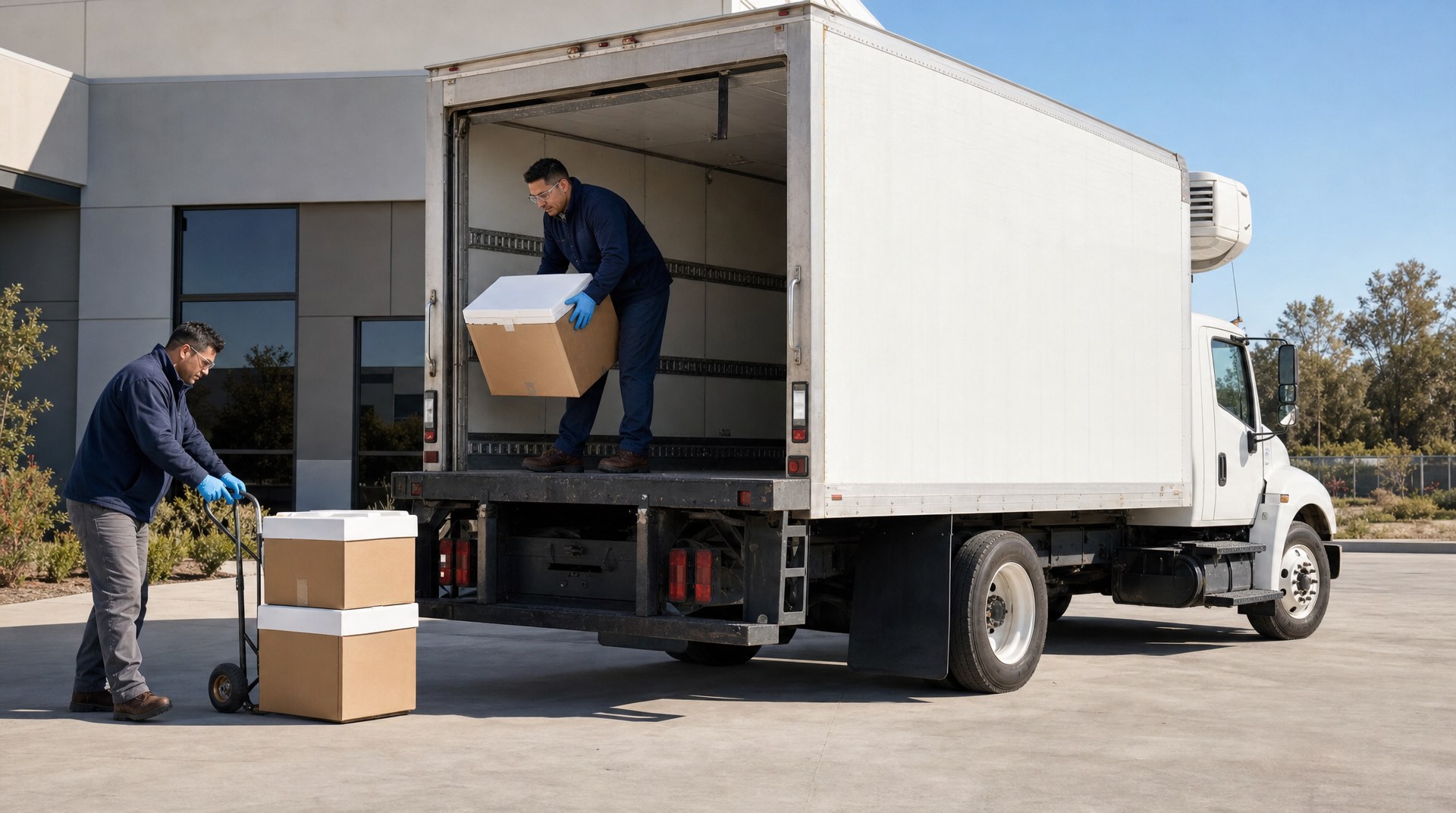
A tube of plasma, a set of tissue swabs, or a box of frozen aliquots looks like a small parcel. For transport purposes it may be a hazardous material. Whether it is, and what the package has to look like, depends on what the sample is, why it is moving, and how it travels. For a biotech team in South San Francisco, Emeryville or on the Peninsula sending samples to a central lab, a CRO or a partner site, the questions come up on every shipment: is this Category B, how does it have to be packed, and does it need temperature control on the truck.
This guide covers shipping specimens by ground in the United States under the federal Hazardous Materials Regulations. It is a summary of the rule text, not a substitute for it, and your biosafety or compliance officer has the final word on how a given sample is classified.
Is your sample a Category B infectious substance?
Under 49 CFR 173.134, an infectious substance is a material known or reasonably expected to contain a pathogen. It falls into one of two categories:
- Category A is an infectious substance in a form capable of causing permanent disability or life-threatening or fatal disease in otherwise healthy humans or animals when exposure occurs. It ships as UN2814, UN2900 or UN3549 under a separate, stricter section, and it is outside the scope of this guide.
- Category B is an infectious substance not in a form generally capable of causing that kind of harm, including material transported for diagnostic or investigational purposes. It must be described as “Biological substance, Category B” and assigned UN3373.
The same section defines patient specimens as those collected directly from humans or animals and transported for research, diagnosis, investigational activities, or disease treatment or prevention. That includes blood and its components, tissue and tissue swabs, excreta and secreta, and specimens in transport media.
Not every specimen is regulated as Division 6.2 at all. Section 173.134(b) lists exceptions, and several of them cover common biotech shipments:
- Non-infectious biological materials, such as non-infectious cells, tissue cultures, DNA, RNA, and blood or plasma from individuals not suspected of having an infectious disease.
- Material containing pathogens that have been neutralized or inactivated so they no longer pose a health risk.
- Dried blood spots and fecal occult blood specimens on absorbent filter paper or other material.
- Human or animal samples sent for routine testing not related to the diagnosis of an infectious disease, such as cholesterol, blood glucose, kidney or liver function, drug testing, or cancer biopsies, where there is a low probability the sample is infectious.
One exception applies only to ground transport. Under 173.134(b)(10), a Division 6.2 material other than Category A, in a patient sample or a biological product, is not subject to these requirements when it is transported by a private or contract carrier in a motor vehicle used exclusively to transport such materials. Medical or clinical equipment and laboratory products may ride in the same vehicle if they are properly packaged and secured. If the material meets the definition of regulated medical waste, the medical waste rules apply instead.
Classification is the shipper’s call, made from what is known about the source and the sample. Write the result down before the shipment is booked, because it decides everything that follows.
How to pack a Category B shipment
Once a sample is Category B, 49 CFR 173.199 sets the packaging. A package that meets it is excepted from the other requirements of the Hazardous Materials Regulations, except incident reporting and a few listed items. The core requirements are:
- Triple packaging. A primary receptacle, a secondary packaging, and a rigid outer packaging. Primary receptacles must be packed so they cannot break, be punctured, or leak into the secondary packaging under normal conditions of transport.
- Cushioning. The secondary packaging must be secured in the outer packaging with cushioning material, so that a leak does not impair the cushioning or the outer packaging.
- Drop test and size. The packaging must pass the drop test in 178.609(d) at a height of at least 1.2 meters (3.9 feet) with no leakage from the primary receptacle, and at least one surface of the outer packaging must measure at least 100 mm by 100 mm.
- The UN3373 mark. A square-on-point (diamond) mark on a contrasting background, with no side shorter than 50 mm, border lines at least 2 mm wide, and letters and numbers at least 6 mm high. The words “Biological substances, Category B” go next to the diamond in letters at least 6 mm high.
- A responsible person. The name and telephone number of a person who knows the material and has emergency response information, or has immediate access to someone who does, must be on a written document such as the bill of lading, or on the outer packaging. The number must be monitored during business hours.
- Manufacturer instructions. Packagings must be filled and closed according to the instructions from the packaging manufacturer or distributor.
- Training. Each person who offers or transports a Category B substance under this section must know its requirements.
Liquids add three requirements: the primary receptacle must be leakproof, the secondary packaging must be leakproof, and absorbent material must sit between them in enough quantity to absorb the entire contents. Several fragile primary receptacles in one secondary packaging must be individually wrapped or separated. Solids need siftproof primary and secondary packagings, and a solid that may become liquid in transit must be packed as a liquid.
Ground versus air: what changes
Some limits in 173.199 apply only to aircraft. The 95 kPa pressure requirement for liquids and the quantity caps of 1 L per primary receptacle and 4 L per outer packaging are written for shipments by aircraft, as is the 4 kg cap for solids. Air carriers also follow the IATA Dangerous Goods Regulations, where Packing Instruction 650 covers UN3373 and adds items of its own.
| Requirement | By ground under 49 CFR 173.199 | By air under IATA PI650 |
|---|---|---|
| Triple packaging, 1.2 m drop test, UN3373 mark | Required | Required |
| 95 kPa pressure capability for liquids | Stated for aircraft shipments | Required |
| 1 L per primary receptacle, 4 L or 4 kg per outer packaging | Stated for aircraft shipments | Required |
| Itemized list of contents between secondary and outer packaging | Not stated in 173.199 | Required |
| Name and address of shipper and consignee on each package | Not stated in 173.199 | Required |
| Responsible person’s name and phone number | On the bill of lading or the package | On the air waybill or the package |
If there is any chance the package will move by air for part of the trip, pack it to the air requirements from the start. Repacking at an airport is where time and sample integrity are lost.
Ice, dry ice and liquid nitrogen
Refrigerants are the one other hazardous material a Category B package may contain, along with anticoagulants and small quantities of preservatives. Section 173.199(d) sets how they are used:
- Ice or dry ice goes outside the secondary packaging or in an overpack, with interior supports that hold the secondary packagings in their original position.
- With wet ice, the outside packaging must be leakproof or have a leakproof liner.
- With dry ice, the outside packaging must let carbon dioxide gas escape and meet 49 CFR 173.217. The package is marked “Carbon dioxide, solid” or “Dry ice”, with an indication that the material is for diagnostic or treatment purposes, such as frozen medical specimens.
- The primary receptacle and secondary packaging must keep their integrity at the temperature of the refrigerant, and there must be enough absorbent to take up all liquid, including melted ice.
Liquid nitrogen and dry ice must also meet the other requirements of the regulations that apply to them. The refrigerant is part of the package design, so plan how long it lasts against the full door-to-door time, including the wait at the receiving dock.
When you need temperature-controlled ground transport
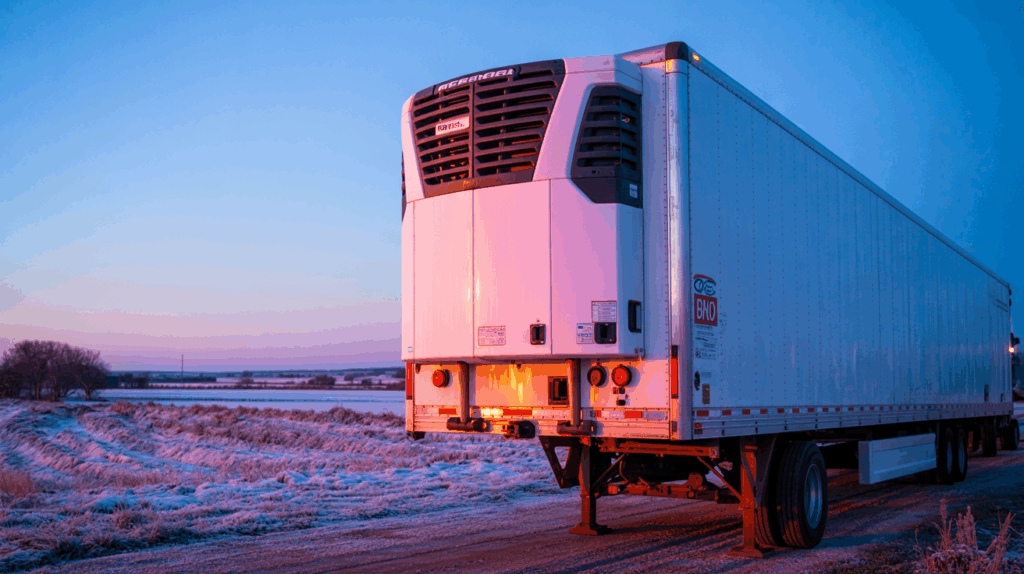
A single insulated box with its own refrigerant often does the job for a small shipment. The truck itself needs to hold temperature when one of these is true:
- The trip outlasts the refrigerant. If the packaging is validated for fewer hours than the trip will take, the vehicle has to carry the temperature for the rest.
- The volume is too large for passive boxes. Pallets of kits, reagents or sample cartons from a study closeout are easier to hold in a controlled trailer than in dozens of separately cooled boxes.
- The range is tight. A protocol that names a narrow range needs equipment set to that range for the whole trip.
- You need a temperature record. If the receiving lab or your quality team needs a continuous log of the shipment, ask for it at booking, not after delivery.
Match the specimen’s required range to what the equipment holds. Our refrigerated freight service lists a refrigerated range of 34°F to 45°F and deep-frozen down to -20°F, with continuous and cycle running modes both available, as full truckload or as temperature-controlled LTL. Frozen samples kept colder than that, such as those held at -70 °C, are a job for a cold-chain and cryogenic courier service rather than a standard reefer. For the basics of how a cold chain is put together, see our guide to cold chain logistics.
Timing matters as much as temperature. Our expedited shipping services offer next-day delivery with nationwide ground or air options for time-definite arrivals, and team-driver trucking for long-distance coverage with minimal stops. Medical devices and lab equipment that travel with the samples follow their own rules, covered in our guide to shipping medical devices.
What to send for an accurate quote
- Pickup and delivery addresses, with the receiving hours and contact at the lab
- Your classification: Category B (UN3373), excepted, or not regulated
- The number of packages, their dimensions and weight, and whether they are on pallets
- The required temperature range, and whether the packages carry their own refrigerant
- The hours the packaging is validated for, if it is passive
- The pickup window and the latest acceptable delivery time
- Any chain-of-custody form the sender or receiver needs signed
How LAX Freight supports specimen and sample shipments
Our medical and life sciences logistics service covers clinical trial sample transport logistics, with precise coordination for sample pickups, multi-site distribution, and chain-of-custody control, along with cold-chain diagnostics and lab reagents. It offers ADR/IMDG/49 CFR-certified shipping of medical devices, reagents, and regulated substances, and comprehensive temperature-controlled shipments from ambient to ultra-cold (-70 °C) range, with full validation available on request. White-glove handling includes custom packaging and secure chain-of-custody processes, and 24/7 live tracking, AI-based exception alerts, and a secure client dashboard give end-to-end visibility.
Send us your classification, the temperature range, the two addresses and the deadline, and we will tell you which option fits the shipment.