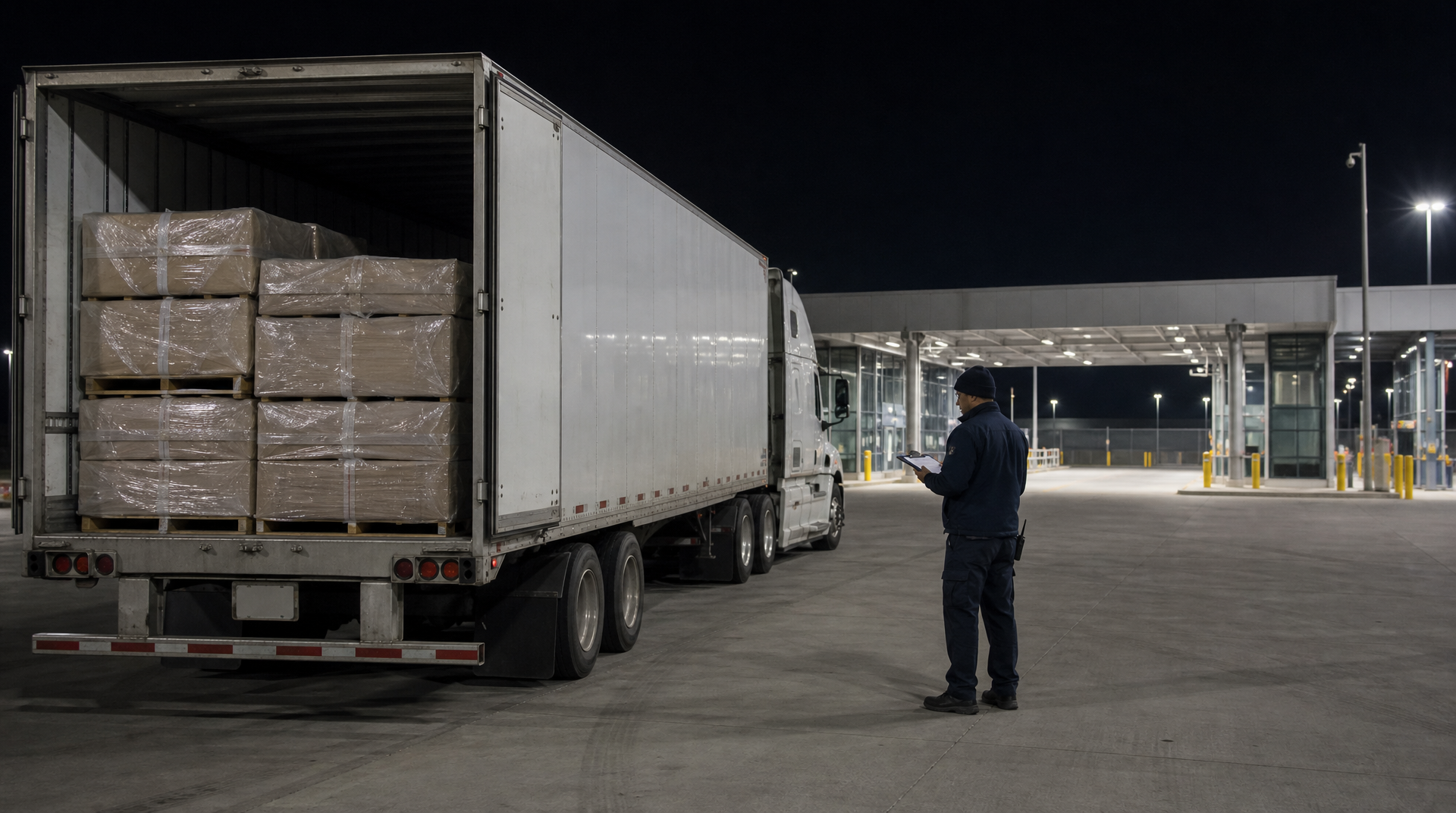
The part is at customs. The line goes down at 6 AM.
The replacement part has crossed the border and is sitting in customs. The line it belongs to stops at 6 AM when the current run finishes, and there is no second part behind it. Between now and then sits a single night, and the part does not have to travel far. It has to clear, get picked up, and reach the plant, and each of those steps belongs to a different party who is not awake, not waiting, and not on the same clock as the others. The distance is short. The coordination is the entire problem.
This is not a speed event. Nothing here is moving slowly because a truck is too far away. It is stalling because clearing customs hands to a trucker who hands to a plant receiving dock, and on an overnight none of those three is automatically ready when the one before it finishes. The part can clear at 1 AM and still lose the morning if the truck that should have been staged at the cargo lot is a four-hour callout instead. Clearing early only helps if the plant can take the part the moment it lands, which is a separate question from arrival.
A short trip with too many owners
What makes the overnight dangerous is that the steps are sequential but the parties are independent. The customs broker files and works the release. Customs acts on its own timeline. A trucker has to be dispatched, drive to the cargo facility, and pull the freight. Plant receiving has to be staffed to take it and move it to the line. Four owners, one clock, and the default behavior of each is to wait until the step before it visibly finishes before starting its own. Stacked across a single night, those waits are what turn a part that cleared at 1 AM into a part that reaches the line at 7.
The overnight, if every party waits its turn
Walked forward against the 6 AM deadline, the cost of a chain where each party starts only when the last one finishes becomes hard to miss.
The part clearing customs is not the milestone. The milestone is every downstream party being ready the moment it clears.
The gap that actually kills it
The failure is almost never customs being slow. It is the hours that open up on either side of the clearance, when a party that could have been staged is instead being woken up and briefed. A trucker dispatched at 1:05 AM, after the release, cannot undo the ninety minutes it takes to get to the cargo facility. Plant receiving discovering at 2 AM that something is inbound cannot conjure a crew that was sent home. Every one of those gaps was avoidable the evening before, while the part was still sitting in customs and everyone treated the clearance as the thing to wait for rather than the thing to be ready for.
The trucker callout is the clearest version of it. A driver dispatched at 1:05 AM, right after the release posts, is not a driver at the cargo lot. He is at home, forty minutes from the yard and another forty from the facility, and the freight is not in hand until close to 3. The same driver, staged in the lot the evening before, is sitting there when the release lands and has the freight on the truck by 1:20. Same driver, same distance, same release time. The only difference is whether the call went out before the clearance or after it, and that single choice is most of the distance between making the morning and missing it.
What overnight coordination actually looks like
The version that holds the morning does almost nothing customs cannot see and everything the downstream parties usually skip. The truck is dispatched and staged at the cargo lot before the release lands, on the expectation that it will. Plant receiving is told that night to expect an early-hours drop and is staffed for it. The broker is positioned to confirm clearance to a driver who is already there, not to a dispatcher who then starts looking for one. None of it makes customs move faster. All of it makes sure that the minute customs does move, there is no second wait behind it. The work of a clean overnight happens before midnight, not after the clearance. The forwarder who runs a cross-border recovery on a deadline is the one staging the back half of the night while the front half is still in customs.
Line up the overnight before the part is held
Three questions decide whether a part that clears overnight actually makes the morning, and all three are about the parties, not the part. Who is staged to pick it up the moment it releases, and were they dispatched before the clearance or after. Is plant receiving staffed and expecting the drop, or will it be a surprise at 2 AM. And who is holding the whole chain together overnight so that clearance hands straight to a staged truck instead of starting a fresh search. Answer those and the customs hold becomes a pause instead of a miss. Map an overnight customs recovery with someone who stages the downstream before the part clears, not after.