More companies are looking for door-to-door freight service between the U.S. and Mexico – and for good reason. Cross-border freight is growing while capacity is tightening. That means moving a shipment successfully isn’t just about finding a truck anymore. It’s about coordinating carriers, customs, border crossings, documentation, and final delivery as one continuous move.
Current market conditions explain why this service has become more valuable in 2026.
Bilateral trade between the U.S. and Mexico hit $147 billion in just the first two months of 2026, keeping Mexico in position as the top supplier of goods to the U.S. February alone accounted for $73 billion in trade, with a $16.8 billion U.S. trade deficit driven by higher imports.
Uber Freight reports that Mexican exports to the U.S. are running roughly 15% higher in recent months, with growth spread across manufacturing rather than concentrated in a single sector. While automotive freight is stabilizing rather than driving gains, much of the strongest growth is coming from electronics, computing equipment, and other advanced manufacturing sectors. Uber Freight’s senior economist told FreightWaves that cross-border freight is shaping up to be a stabilizing force for North American trucking demand in 2026, even as the rest of the market struggles with tariff uncertainty.
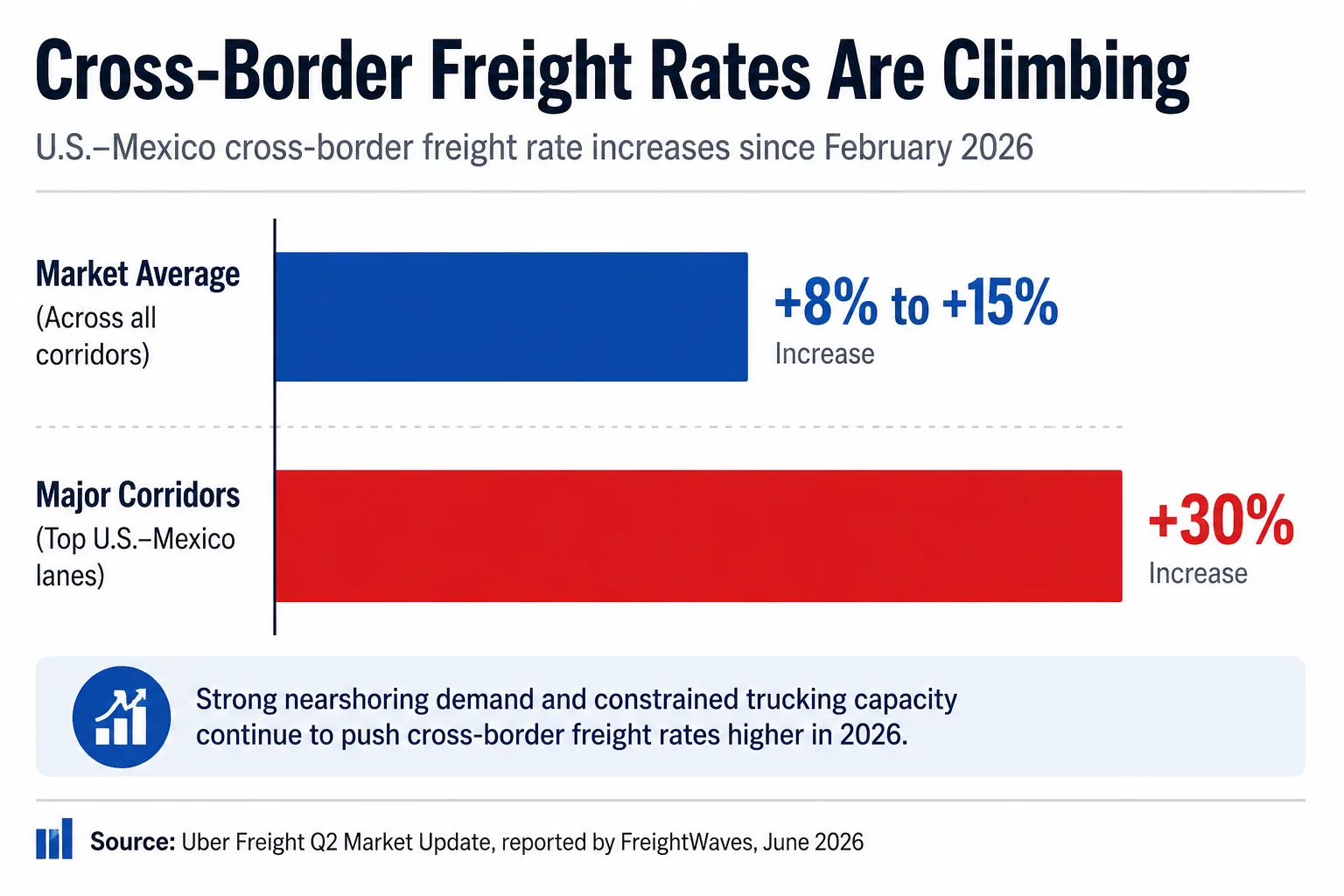
That stronger demand is already showing up in pricing. Uber Freight’s Q2 Market Update says cross-border freight rates have increased 8%–15% across the market since February, with some major U.S.–Mexico corridors seeing increases approaching 30% in just two months.
Capacity, not demand, is the real constraint
This is the operational detail that matters most for shippers right now: the bottleneck isn’t whether freight exists, it’s whether there’s capacity to move it through cross-border logistics networks. C.H. Robinson’s April 2026 update stated it directly – “the defining challenge for shippers in Q2 is not demand but securing reliable capacity,” with tightening conditions across key export and cross-docking lanes.
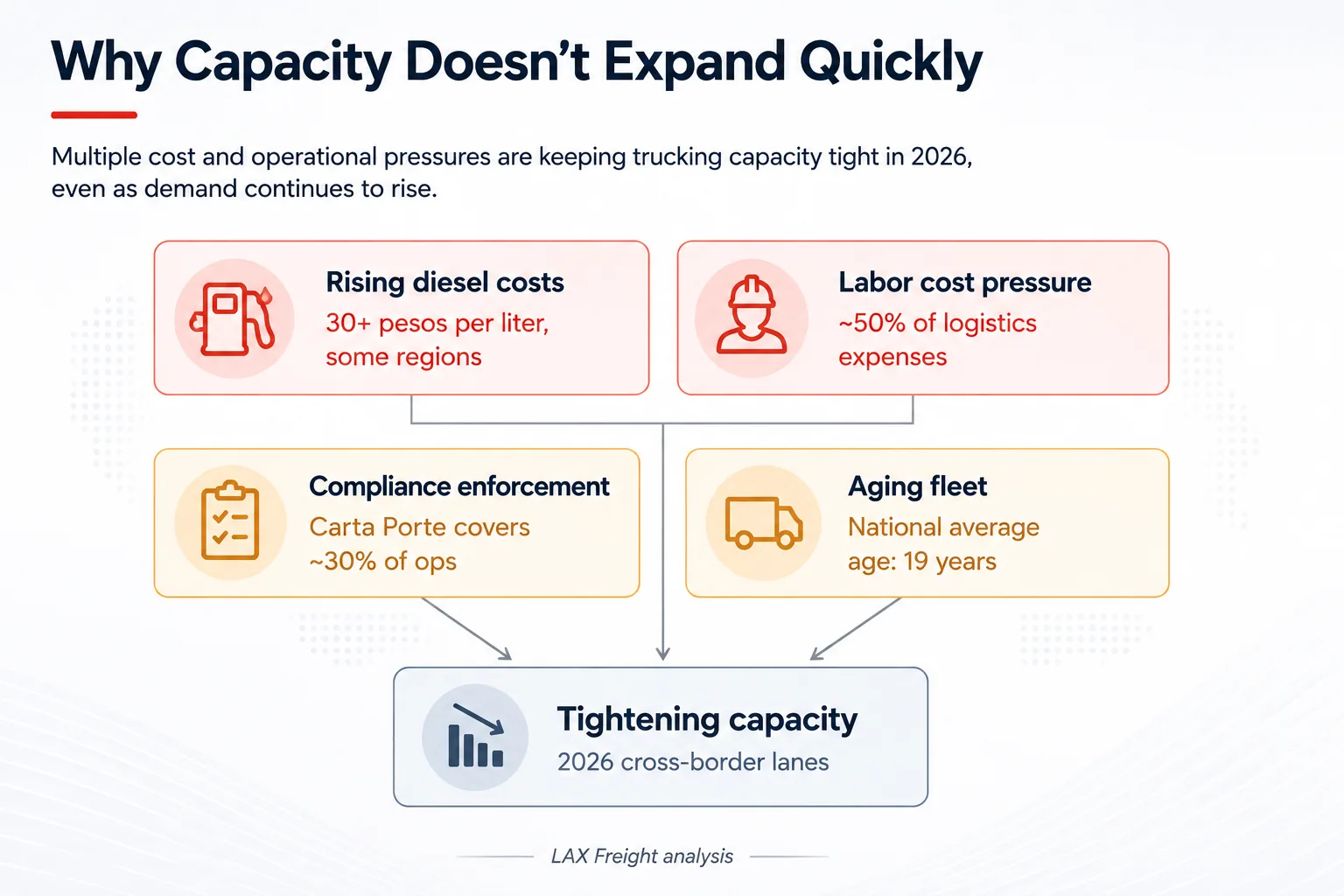
Several forces are converging to squeeze capacity on the Mexico side specifically:
- Rising operating costs. Diesel in Mexico has climbed sharply, with some regions hitting or exceeding 30 pesos per liter, and the government has had to lean on a subsidy mechanism to limit the pass-through to consumers.
- Labor cost pressure. Labor now makes up nearly half of logistics expenses in Mexico, with minimum wage increases and regulatory changes compressing carrier margins.
- Compliance enforcement. Mexico’s Carta Porte enforcement is ramping up, with inspections expected to cover roughly 30% of trucking operations – a meaningful jump from prior years.
- Aging fleet. The Mexican government’s response – a 6-billion-peso fleet renewal program – is targeted at owner-operators specifically because the national fleet’s average age is 19 years old, which says a lot about why capacity doesn’t expand quickly even when demand calls for it.
Regulatory enforcement is tightening capacity further
Capacity constraints aren’t being driven by economics alone. Stricter enforcement of existing U.S. cross-border requirements – including B-1 visa rules, English-language proficiency standards, and rules restricting Mexican carriers from cabotage within the U.S. – has reduced the number of drivers willing or able to operate cross-border routes. According to C.H. Robinson’s June 2026 update, thousands of drivers across border regions have reportedly been taken out of action in recent weeks, a disruption compounded by the timing of Roadcheck Week.
The effect compounds itself: some drivers are now avoiding cross-border loads entirely, choosing to carry only intra-Mexico freight rather than risk inspection or visa revocation. That’s a behavioral shift, not a shortage of trucks – capacity is disappearing because drivers are choosing not to cross, which suggests the disruption may turn out to be structural rather than temporary. Load-to-truck ratios on some lanes have already moved into double-digit territory as backlogs build at the border.
Underlying all of this is a more basic constraint: Mexico doesn’t have enough drivers, full stop. The challenge isn’t finding freight – it’s finding enough qualified people to move it, and that gap doesn’t close just because demand rises.
Mexico’s driver shortage:
- Current shortage: 60,000 to 80,000 operators
- Projected shortage: 100,000+ in the coming years
- Result: capacity cannot expand as fast as freight demand
On the U.S. side, Lance Dixon, Werner’s SVP of Mexico, Canada and Temperature Controlled Operations, expects tighter border operations to place additional pressure on truckload capacity. Werner is responding by expanding its owned intermodal container fleet in Mexico from roughly 400 to 800 units in anticipation of continued growth in cross-border freight.
Why this isn’t a short-term spike
The case for sustained, rather than temporary, demand in Mexico’s trucking market is rooted in long-term manufacturing investment. Companies expanding production don’t commit to additional facilities overnight – they invest in land, equipment, infrastructure, and workforce development years before those plants begin operating. That pipeline of investment is expected to support freight volumes well beyond the current market cycle. Werner has echoed this outlook, noting that the manufacturing capacity being built in Mexico today is likely to generate freight demand for years to come, with truckload capacity facing increasing pressure as production continues to expand.
Mexico’s FDI confidence ranking backs this up at the macro level – the country jumped from 25th to 19th in Kearney’s 2026 Foreign Direct Investment Confidence Index, one of the largest gains globally alongside Singapore, reflecting investors increasingly targeting production hubs closer to end markets.
Another indicator points the same direction: imports of intermediate goods into Mexico rose nearly 30%, suggesting manufacturers are continuing to bring in the components needed for future production rather than simply drawing down existing inventory. That kind of input demand is typically a leading indicator for future outbound freight, not a one-time blip.
Where the freight is actually moving
This isn’t evenly distributed across the border. Texas crossings continue to dominate, shaping capacity, pricing and infrastructure demand across cross-border transportation networks. Infrastructure investment is following the volume: Mexico has opened a new 29-hectare national customs facility in Nuevo Laredo and continues investing in customs inspection technology to support growing cross-border trade.
Compliance update: Mandatory enforcement of Mexico’s Manifestación de Valor Electrónica (MVE) has been extended from June 1 to July 31, 2026, giving importers additional time to prepare documentation. The deadline moved, but the requirement hasn’t – shippers who treat the extension as prep time rather than a pause will be the ones moving freight without disruption once enforcement begins.
What this means for shippers
Put together, the data points to a specific operating reality, not a general trend. If you’re moving freight between the U.S. and Mexico, booking transportation is becoming less about finding a truck and more about securing the right capacity before the market tightens further. Carrier selection, border handoffs, customs partners, and delivery scheduling all become more important as available capacity gets harder to secure.
Demand isn’t the question – securing capacity is. Shippers who wait until a lane tightens to start looking for trucks are negotiating from a weaker position than those with freight already booked.
The border handoff is where execution risk concentrates. With inspection rates rising and compliance enforcement tightening, a clean handoff between origin pickup, border crossing, and final delivery matters more than it did a year ago – not less.
Carriers are already repositioning capacity toward this corridor, which means the providers paying attention now are better positioned than those treating Mexico freight as an afterthought.
How door-to-door coordination reduces execution risk
Most of the risk in a cross-border Mexico move doesn’t happen mid-transit – it happens at the handoff. A load gets picked up at origin in Mexico, runs to the border, then handed off to a different carrier or a drayage provider on the U.S. side. That’s the point where freight sits longest, documentation gets double-checked, and small errors turn into multi-hour delays.
Booking a door-to-door shipment as a single coordinated move changes that dynamic by putting one party in charge of the full route, instead of stitching together multiple providers and hoping the handoffs line up.
Not every cross-border shipment follows the same operating model, either. Depending on the commodity, destination, customs process, and carrier network, freight may stay on the same trailer all the way through the border (a through-trailer move) or get transferred to another trailer or carrier at a cross-dock or transload facility.
The right approach depends on transit time requirements, equipment availability, and border operations – not every shipment benefits from the same model, and picking the wrong one is its own source of delay.
A few things matter most in making that work in practice:
- Carrier selection on both sides of the border. Not every carrier with U.S. authority runs efficiently into Mexico, and not every Mexican carrier is positioned to handle the U.S.-side delivery. Coordinating cross-border freight between the U.S. and Mexico means matching the right equipment and route experience to each leg, not defaulting to whichever truck happens to be available.
- A clean handoff at the crossing. With Carta Porte enforcement and inspection rates both climbing, the border crossing itself is where documentation gaps turn into hours of delay. Pre-arranged handoffs – carrier-to-carrier or within the same network – cut that exposure significantly compared to ad hoc arrangements made at the last minute.
- Customs partners who are actually licensed for it. Cross-border logistics only works smoothly when the customs side is handled by a properly licensed broker, not bundled in as an afterthought by a provider whose core competency is trucking. Treating that as a distinct, accountable piece of the move – rather than assuming it’s covered – is what prevents paperwork issues from becoming shipment delays.
- Delivery scheduling that accounts for variability. Border wait times aren’t constant, and a schedule built around best-case crossing conditions breaks the first time conditions aren’t ideal. Realistic scheduling – padded for the crossing, not just the highway miles – is what keeps a Mexico trucking lane reliable instead of merely fast on paper.
None of this is exotic. It’s the same discipline good freight brokers apply everywhere – it just matters more on this corridor right now, because the margin for error is shrinking as capacity tightens.
As capacity tightens, execution becomes more valuable than simply finding an available truck. Delays at the border, carrier handoffs, and documentation issues become more expensive when replacement capacity isn’t readily available.
How LAX Freight fits into this
As a freight broker, LAX Freight’s role on cross-border Mexico moves is to plan and coordinate the full transportation leg – sourcing the right carrier(s) for the route, managing the handoff at the border crossing, and keeping the shipment visible and accountable from origin pickup to final delivery.
On the regulatory side, we work alongside licensed customs brokers to handle documentation and crossing requirements; we don’t position ourselves as the customs broker of record, but we make sure that piece of the move is covered by the right partner so it isn’t the weak link.
Given how the data above shapes up – tightening capacity, rising compliance enforcement, and a demand base that’s backed by multi-year investment rather than a seasonal blip – that kind of coordination matters more for Mexico freight services in 2026 than it has in past years.
Frequently Asked Questions
Why are U.S. to Mexico cross-border freight rates rising in 2026?
Rates are up 8% to 15% market-wide and close to 30% on some major corridors since February 2026. The driver is tight trucking capacity, not weak demand. Rising diesel and labor costs, stricter Carta Porte and B-1 and cabotage enforcement, and an aging Mexican fleet all limit available trucks while nearshoring keeps volumes high.
What is door-to-door cross-border freight service?
It is a single coordinated move from origin pickup to final delivery across the border, instead of a series of disconnected stages. One provider manages carrier selection, customs documentation, the border handoff, and the final delivery leg, so the shipment stays accountable from start to finish.
Where do most U.S. to Mexico freight delays actually happen?
Usually at the handoffs, not on the highway. Most delays occur in the transitions between pickup, customs, the border crossing, and final delivery, where a documentation gap or scheduling conflict turns into hours of lost time. Preparing paperwork before the crossing and arranging handoffs in advance prevents most of them.
How should shippers plan cross-border freight in a tight-capacity market?
Start earlier. As capacity gets selective, booking close to pickup means fewer carriers and higher rates. Line up experienced carriers on both sides of the border, work with licensed customs brokers, prepare documentation ahead of the crossing, and build schedules with extra time for border conditions.
Need to move freight between the U.S. and Mexico? Learn more about our Cross-Border Freight Services or contact our team to discuss your next door-to-door shipment.