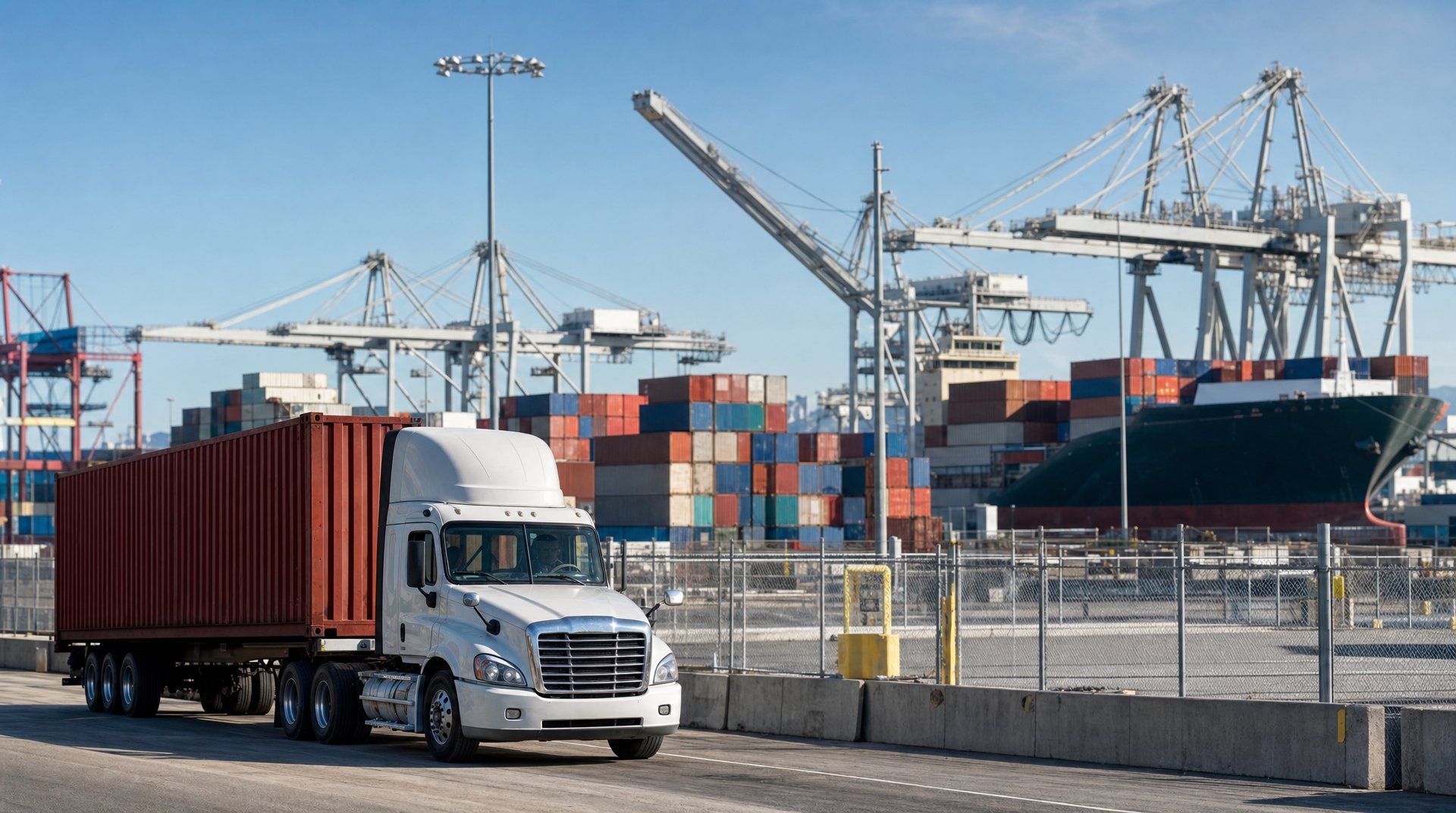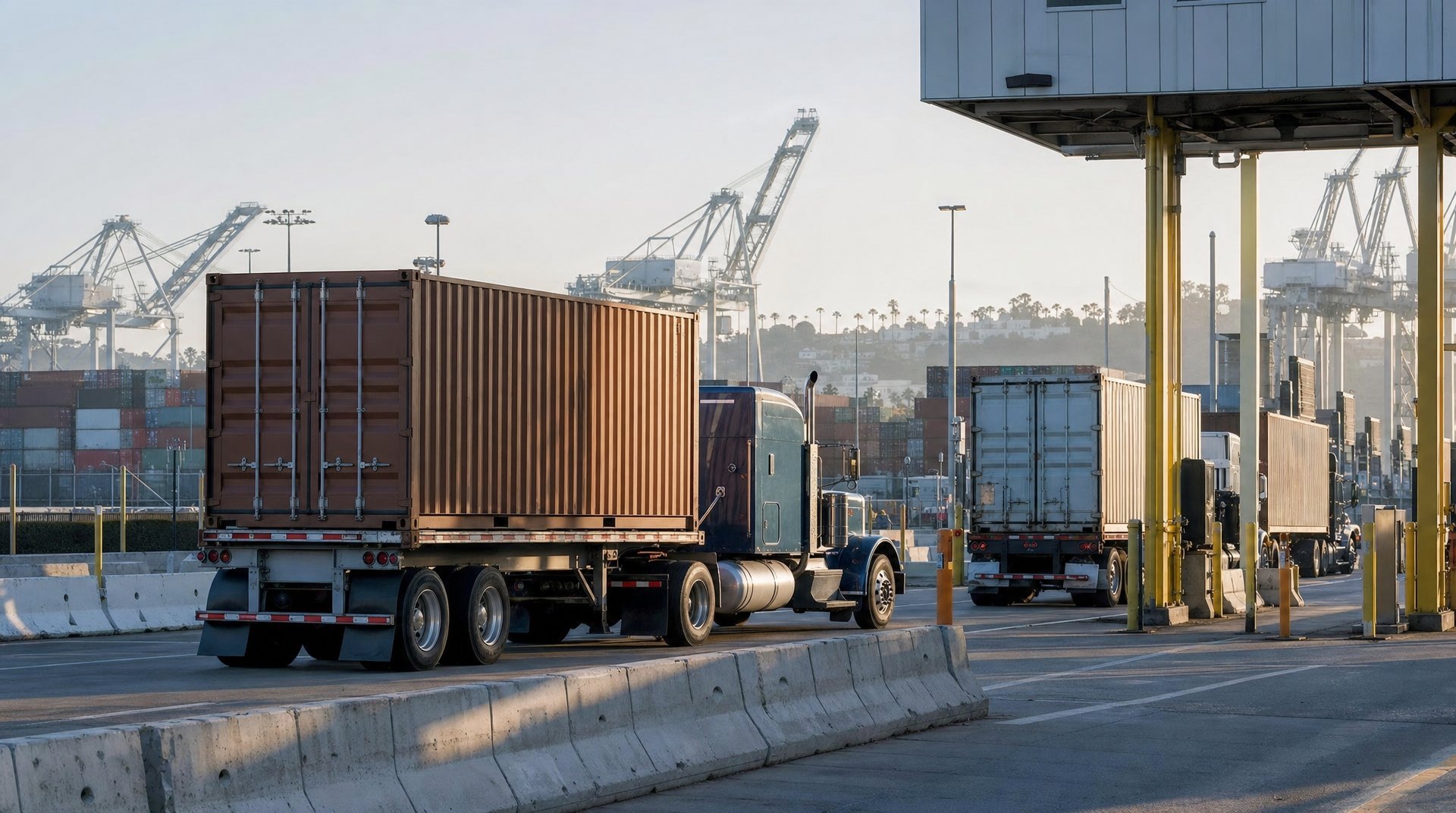
A drayage price from the Ports of Los Angeles and Long Beach is not one number. It is a base haul from the terminal to your door, plus a set of lines that only appear when something about the container, the terminal or the timing calls for them. The base haul is the part you compare between carriers. The other lines are where an invoice grows, and most of them depend on how fast the container gets picked up, unloaded and returned.
Below: each line on a typical LA and Long Beach drayage bill, who charges it, when it applies, and how to keep it small. There are no universal rates here on purpose, because they move with the terminal, the distance, the container and the week. The few fixed figures below come from public sources and are linked.
What goes into a drayage quote from LA and Long Beach?
Most quotes and invoices are built from the same lines. Not every move has all of them, and carriers name them differently, but this is the full list worth asking about before you book:
| Line | Who charges it | When it applies | How to keep it down |
|---|---|---|---|
| Base haul | Drayage carrier | Every move: terminal to your door, then the empty back to where the ocean carrier wants it | Give the exact delivery address, receiving hours, and whether it is a live unload or a drop |
| Fuel surcharge | Drayage carrier | Most quotes, usually as a percentage or per mile on top of the base | Ask whether the quote already includes it |
| Chassis | Chassis provider, usually passed through by the carrier | For each day the container sits on a chassis | Unload fast and ask how chassis days are counted |
| Pre-pull | Drayage carrier | The container leaves the terminal before your delivery date and is parked in the carrier’s yard | Use it when free time at the terminal is running out, not by default |
| Yard storage | Drayage carrier or yard | Each day a pre-pulled container waits in the yard | Book your delivery appointment before the pre-pull |
| Port and terminal fees | Collected for the ports and terminals, usually passed through | Loaded containers moving through the terminal gates | Not avoidable by scheduling; check that they appear as pass-through amounts |
| Demurrage | Terminal or ocean carrier | The container stays in the terminal past its free time | Confirm release early and pick up inside free time |
| Detention or per diem | Ocean carrier that owns the container | The container stays out of the terminal past its free days | Unload quickly and get the empty back |
| Waiting time | Drayage carrier | The truck waits at the terminal or your dock past the free time in the quote | Have the dock and the paperwork ready; ask how many free hours are included |
| Dry run | Drayage carrier | The truck is sent but cannot pick up or deliver, for example because of a hold or a missed appointment | Check holds and appointments before dispatch |
| Exam moves | Exam station operator, plus the drayage carrier for the extra trips | CBP selects the container for an intensive exam | Cannot be avoided once selected; keep shipment documents accurate and plan for additional time and moves |
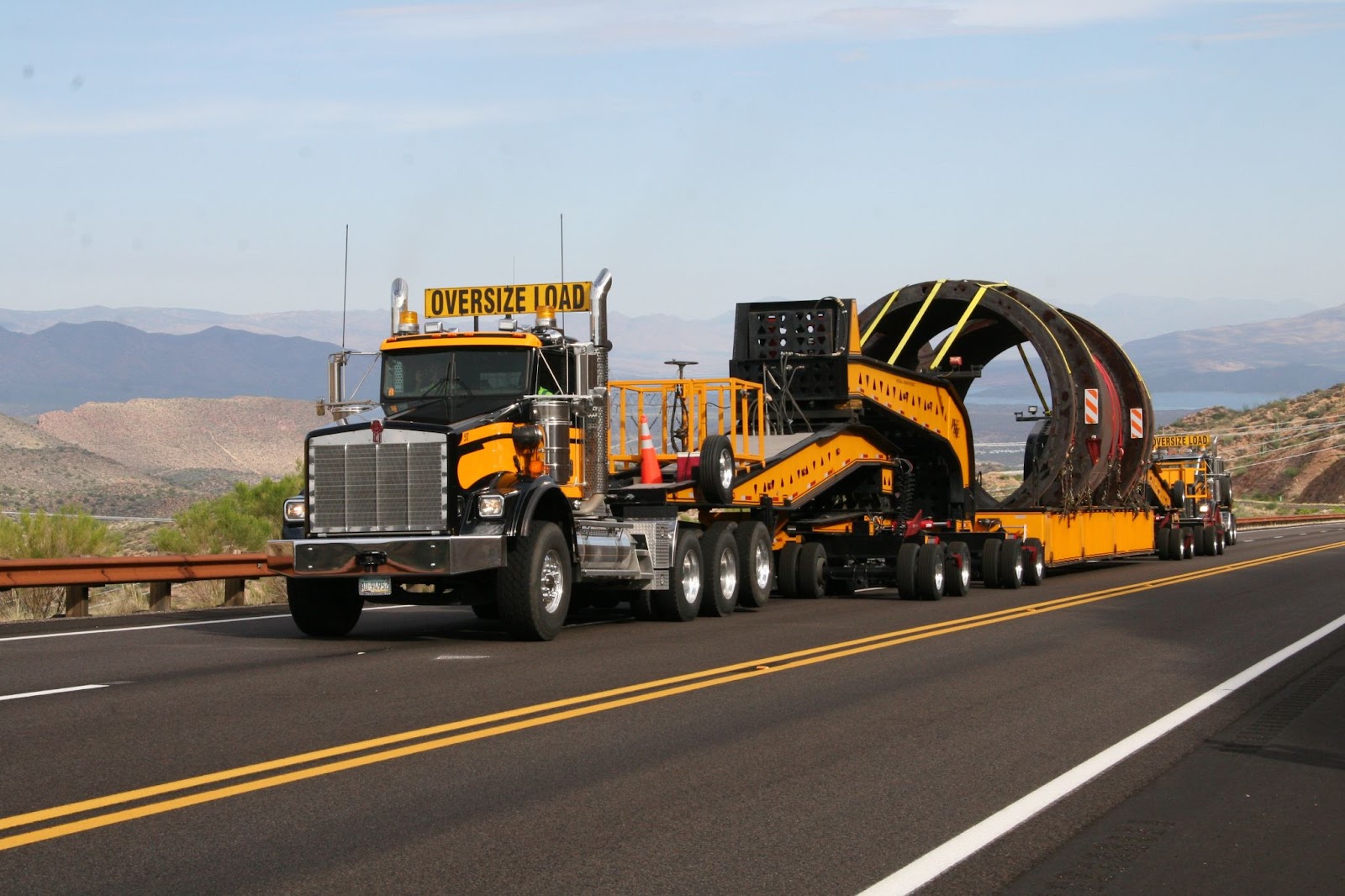
| Overweight | Drayage carrier | A heavy container needs special equipment or a permit to stay within road weight limits | Declare the cargo weight when you ask for the quote |
The pattern in the last column: most of the extra lines are time. A container that is released, picked up inside free time, unloaded the same day and returned the next one carries few of them. A container that waits at any step picks them up one day at a time.
Which charges are fixed public fees?
Two terminal-related charges at LA and Long Beach are set by programs, not by your trucker, and usually show up on the bill as pass-throughs:
- Clean Truck Fund rate. According to the Port of Los Angeles, cargo owners pay $10 for every loaded twenty-foot equivalent unit (TEU) hauled through the port by conventional drayage trucks, and $20 for larger containers. Cargo moved by zero-emission trucks is permanently exempt, and cargo moved by certain lower-NOx trucks is exempt through December 31, 2027. The Port of Long Beach collects the same rate.
- Traffic Mitigation Fee (TMF). PierPass, the not-for-profit set up by the container terminal operators at the two ports, says the TMF funds the night and Saturday OffPeak shifts and is required for most cargo movement at LA and Long Beach. The rate changes over time, so check the current figure with PierPass instead of reusing an old quote.
Everything else on the bill, including the base haul, is priced by the carrier or the container owner and can be compared between quotes.

How do demurrage and detention end up on a drayage bill?
Demurrage and detention are not trucking charges. They come from the terminal or the ocean carrier, and they run on two different clocks: demurrage while the container is still in the terminal, detention while it is out with you. The trucker controls neither clock, but the trucker’s timing decides how long each one runs. Our guide to demurrage vs detention explains where each clock starts and stops.
If you receive a demurrage or detention invoice from an ocean carrier or a marine terminal operator, federal rules in 46 CFR part 541 set what it must contain:
- Required details (541.6). The bill of lading and container numbers, the port of discharge for imports, and why you are the party being billed. Then the free time and its start and end dates, the container availability date for imports, and the exact days charged. Then the tariff or contract rule behind the daily rate, the rate itself, and a contact and process for requesting mitigation, a refund or a waiver.
- Missing details (541.5). If the invoice leaves out required information, the billed party has no obligation to pay it.
- 30-day billing window (541.7). The invoice must be issued within 30 calendar days from the date the charge was last incurred, or you are not required to pay.
- 30 days to dispute (541.8). You get at least 30 days from the invoice to request mitigation, a refund or a waiver, and the billing party must try to resolve the request within 30 days.
Keep the dates that prove when the container was available, picked up and returned. They are what a dispute is decided on.
When does a customs exam add to the bill?
When CBP selects a container for an intensive exam, it is moved to a Centralized Examination Station (CES). Under 19 CFR part 118, the CES operator charges for its services according to its own fee schedule and bills the user directly (118.4). The fees must be comparable to those charged for similar services in the area, and the operator has to give the port director 90 days’ notice before changing them (118.5).
On the trucking side, an exam usually means extra moves: from the terminal to the exam station and from the station to you. While the exam runs, the container is out of your hands, so plan the delivery date and the free time around it.
Why does container weight change the price?
On the Interstate system, federal rules cap gross vehicle weight at 80,000 pounds, with lower limits where the bridge formula requires them, 20,000 pounds on a single axle and 34,000 pounds on a tandem (23 CFR 658.17). That total includes the tractor, the chassis and the empty container, not only your cargo. A heavily loaded container can need special equipment or a permit, which is why a quote that does not ask for the weight is not final yet.
How do you compare two drayage quotes?
Ask both carriers the same questions, in writing, and line the answers up:
- Is the fuel surcharge inside the price or on top of it?
- How are chassis days counted, and what does one day cost?
- How many free hours of waiting are included at the terminal and at your dock?
- What do a pre-pull and a day of yard storage cost?
- Which port and terminal fees are passed through, and at what amount?
- What happens to demurrage or detention if the truck is late for a reason on the carrier’s side?
- Will the container go to a container freight station first? If it is a shared LCL box, the answer is usually yes; see what a CFS is.
The lower base rate is not always the cheaper move. The quote that answers these questions clearly is the one you can budget.
How LAX Freight prices drayage
Our drayage service covers the Ports of Los Angeles and Long Beach, other California terminals and intermodal rail hubs. We price each move on the terminal location, the distance to destination, the container type and load status, and accessorials such as chassis use, storage time and appointment fees. We have chassis pool access, secure storage and yard holding, live unload and drop and pick options, and transloading when the freight needs to continue inland.
Send the terminal, the container details and the delivery address. Our dispatchers can provide a same-day quote, and real-time status updates once the container moves.